Dvořák earned his living as a viola-player in a band that became the nucleus of the Czech Provisional Theatre Orchestra, where Bedřich Smetana was later appointed conductor.
Composer Biography
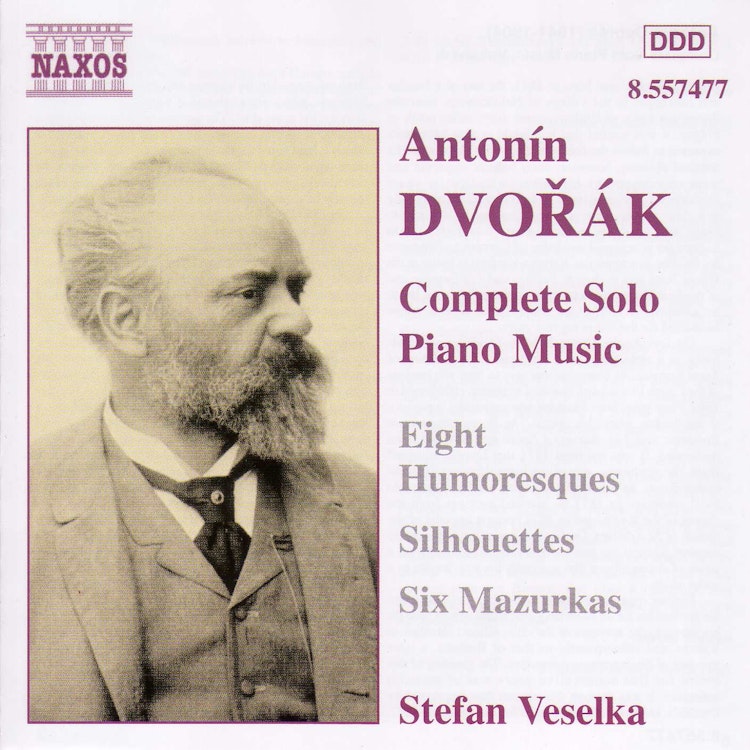
Antonín Dvořák, the composer, was born in 1841, the eldest son of a butcher and innkeeper, and was initially expected to follow the family trade.
Composition History
Dvořák's music gained wider recognition when his application for an Austrian government award brought it to the attention of critic Eduard Hanslick and composer Johannes Brahms.
Compositional Technique
The Humoresques, Dvořák's last great work for piano, are characterized by an American influence, including pentatonic melodies and a sense of good humor.
Composer's Artistic Vision
Dvořák's time as director of the National Conservatory of Music in New York was intended to provide a blueprint for American national music, following the example of Czech national music.
Composition History
The Silhouettes, Op. 8, developed and reprocessed themes from Dvořák's earlier song-cycle Cypresses, which he possibly wrote to express unrequited love for Josefina Čermáková.
Performer Biography
Stefan Veselka, the pianist on this recording, was born in Norway to Czech parents and is related to the composer Leoš Janáček.