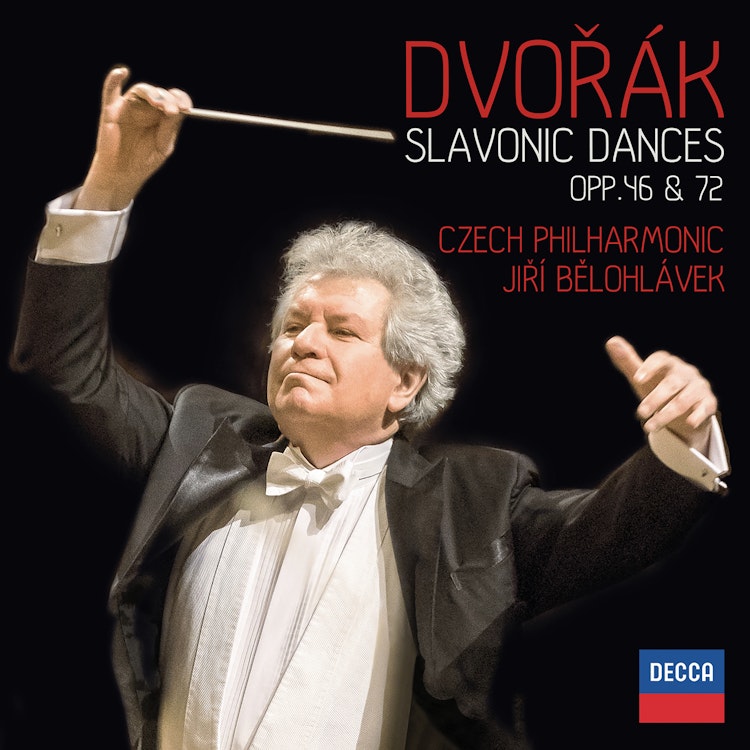
This album was recorded in the Dvořák Hall of the Rudolfinum in Prague, with the two sets of Slavonic Dances recorded in December 2014 and October 2015 respectively.
Composer Biography
Johannes Brahms, a renowned German composer, played a crucial role in Dvořák's career by introducing him to his own publisher, Franz Simrock, and advocating for his talent.
Composition History
The idea for Dvořák's Slavonic Dances came from his publisher, Franz Simrock, who suggested them after the success of Brahms's Hungarian Dances.
Critical Reception
The Slavonic Dances brought Dvořák immediate fame in Germany after an influential critic, Louis Ehlert, praised them as the work of a 'one hundred per cent talent'.
Composer's Artistic Vision
Dvořák's second set of Slavonic Dances (Op. 72) was composed when he was more experienced, resulting in greater subtlety and range compared to the 'fresh, easy, spontaneous' first set (Op. 46).
Compositional Technique
Unlike Brahms's Hungarian Dances, Dvořák's Slavonic Dances do not use real folk melodies but instead draw on characteristic folk styles and rhythms as inspiration for his own original compositions.
Composer's Artistic Vision
Dvořák initially resisted composing a second set of Slavonic Dances, telling his publisher that 'to repeat the Slavonic Dances won't be so easy as it was the first time. To do the same thing twice is devilishly difficult.'
You might also enjoy...
Dvorák: Slavonic Dances, Op. 46 & 72
Wiener Musik Vol. 8
Wiener Musik Vol. 2
Viennese Waltzes and Polkas
Blaue Donau u.a.
Viennese Waltzes and Polkas
Walzer & Polkas
Viennese Waltzes and Polkas
Strauss: Valses Et Polkas
Wiener Musik Vol. 6
Wiener Bonbons - Robert Stolz dirigiert Johann Strauss