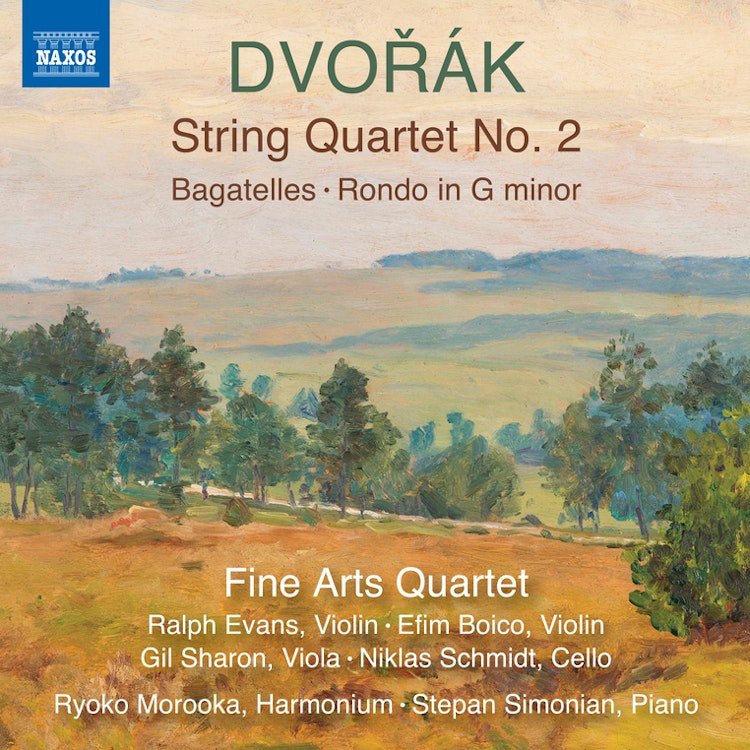
Dvořák: String Quartet No. 2, Bagatelles & Rondo, B. 171
1/12/2024, 10 Tracks, 1:15:05
Featuring
Ralph Evans
Efim Boico
Niklas Schmidt
Ryoko Morooka
Gil Sharon
Stepan Simonian
Fine Arts Quartet
Antonín Dvořák
Did you know?
1/7
Composition History
Dvořák's Bagatelles, Op. 47, were written between his piano and violin concertos and are contemporary with his Serenade for Winds and the first set of Slavonic Dances.
Composer Biography
Antonín Dvořák, a self-confessed 'simple Czech musician,' is celebrated for his distinctive style, which brought him international fame.
Composition History
Dvořák's G minor Rondo, Op. 94, was originally for cello and piano and was written for his farewell tour of Bohemia and Moravia before he became director of New York's National Conservatory of Music.
Composer Biography
In his youth, Dvořák was greatly influenced by Richard Wagner, attending his concerts in Prague and expressing his admiration.
Composition History
Dvořák drafted three string quartets, including the String Quartet No. 2, between 1869 and 1870, during his 'strongly Wagnerian phase,' and initially burned the scores, though the parts survived.
Compositional Technique
Dvořák's String Quartet No. 2 in B flat major is one of his longest chamber works, featuring a largely open-ended, through-composed, and broadly monothematic structure that eschews Classical sonata design.
Compositional Technique
The Bagatelles, Op. 47, are scored for two violins, cello, and harmonium, with the harmonium's reed timbres and sustaining abilities being crucial to its sound.
You might also enjoy...
Hemsi: Chamber Works
Block: Chamber Works
The Piano Trio Collection - Mendelssohn: Trio No. 2 in C Minor, Op. 66 - Arensky: Trio No. 1 in D Minor, Op. 32 - Turina: Trio No. 1, Op. 35 - Heifetz Remastered
Chamber Music (Bohemian and Hungarian) - Dvorak, A. / Brahms, J. / Liszt, F. / Farkas, F. / Smetana, B.
Shostakovich: Piano Quintet; Piano Trio No. 2; String Quartet No. 1
Hommage à Paul Caro [chamber works]
Dvorak, A.: Piano Quartets
Mendelssohn / Smetana: Piano Trios
Shostakovich: Piano Quintet in G Minor / Piano Trio No. 2
Haba Quartett & Haiou Zhang
Saint-Saëns & Taneyev: Taste the Best
Spohr: Quintett in C Minor, Op. 52 & Oktett in E Major, Op. 32
Reger, M: String Trios and Piano Quartets (Complete), Vol. 2 - Piano Quartet, Op. 133 / String Trio, Op. 141B