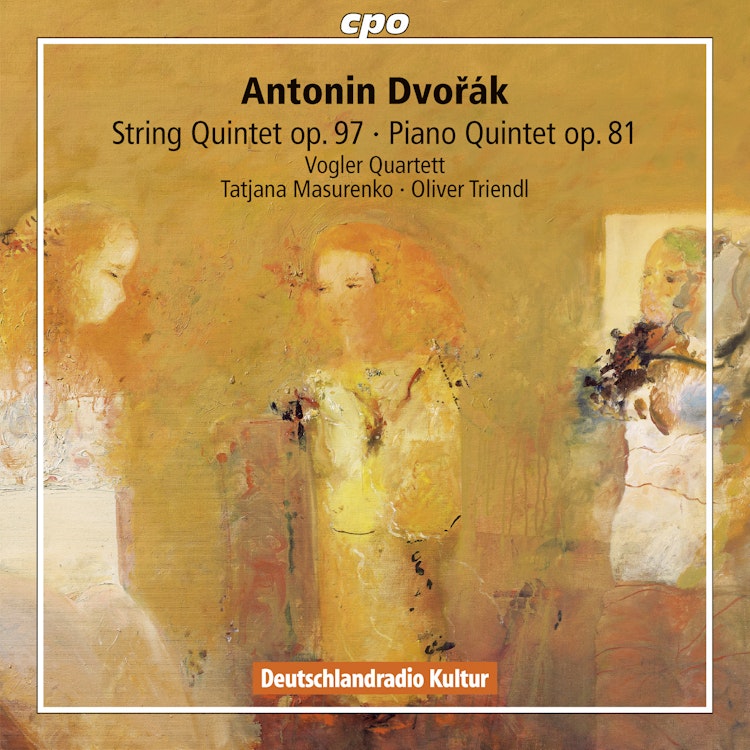
Dvořák: String Quintet No. 3 & Piano Quintet No. 2
12/24/2016, 8 Tracks, 1:13:20
Featuring
Tim Vogler
Frank Reinecke
Stefan Fehlandt
Tatjana Masurenko
Stephan Forck
Oliver Triendl
Vogler Quartett
Antonín Dvořák
Did you know?
1/7
Composer Biography
Antonín Dvořák wrote over forty chamber music works, including two piano quintets and three string quintets, covering almost every traditional ensemble genre.
Composition History
Dvořák accepted the directorship of the National Conservatory of Music in New York in 1885, founded by millionaire's wife Janette Thurber, with the goal of establishing American national music.
Composition History
Dvořák decided to write his Piano Quintet op. 81 after finding his earlier Piano Quintet op. 5 could not be reworked due to his changed compositional style.
Composition History
Dvořák's String Quintet op. 97 was composed in Spillville, Iowa, a Bohemian settlement where he spent a summer and observed Iroquois dances and songs.
Compositional Technique
In his String Quintet op. 97, Dvořák used pentatonic scales and sparse accompaniment for solo melodies, departing from the traditional European chamber music ideal of equally balanced voices.
Composer's Artistic Vision
Dvořák was deeply interested in the folk music of African Americans and Native Americans, intending to draw attention to this 'splendid treasure of melody' in his compositions.
Composer's Artistic Vision
Dvořák, a Pan-Slavist, incorporated folkloric elements into his chamber music, such as the Ukrainian 'Dumka' and the Czech 'Furiant' in his Piano Quintet op. 81.
You might also enjoy...
Dvořák: Piano Quintet in A Major, Op. 81, B. 155 & Echo of Songs, B. 152