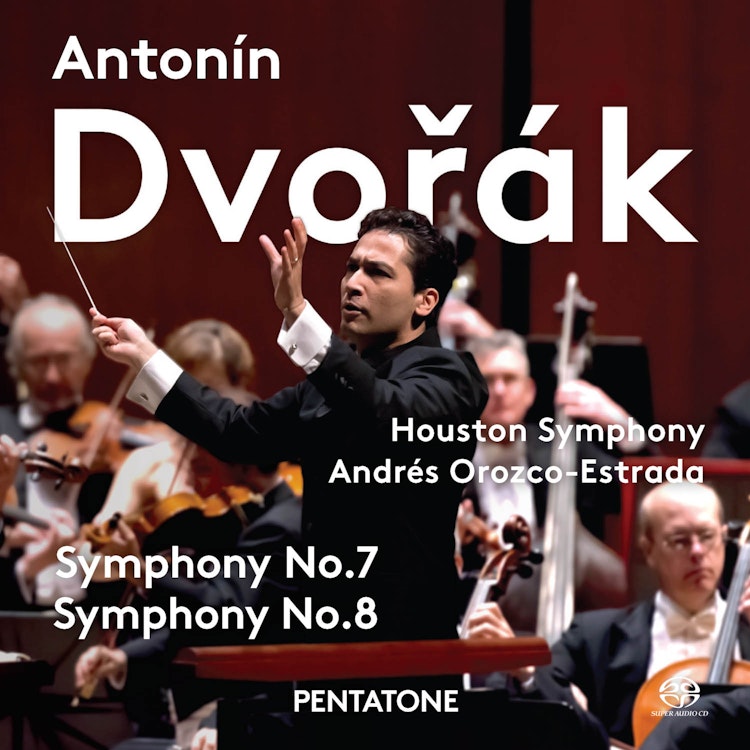
Dvořák sought to infuse his music with the love of his homeland and cultural roots, blending Bohemian melodies and Slavonic folk tradition into his orchestral works.
Performer Biography
Andrés Orozco-Estrada, the conductor of this recording, identifies with Dvořák's fusion of worlds due to his own background combining European tradition with his Colombian heritage.
Recording & Production
This album was recorded live at Jesse H. Jones Hall for the Performing Arts in Houston, Texas, with Symphony No. 7 recorded in April 2014 and Symphony No. 8 in March 2015.
Compositional Technique
In Symphony No. 8, Dvořák aimed to break free from 'usual, universally applied and recognised forms,' notably in its first movement where a cello melody serves as a touchstone rather than a main motif.
Composer Biography
Dvořák, despite his fame, faced challenges from the Austro-Hungarian Empire, which ruled his homeland, such as Vienna's royal opera house balking at staging his Czech operas.
Performer Biography
Andrés Orozco-Estrada, the conductor, began his musical studies on the violin and started conducting at age 15, later studying at the Vienna Music Academy.
Composition History
Dvořák's Symphony No. 7 was partly inspired by his Czech pride and the treatment of his homeland by the Austro-Hungarian Empire, with its agitated opening theme coming to him after seeing Czech patriots arrive in Prague.
You might also enjoy...
Raff: Symphonies Nos. 4 and 11
D'Indy: Symphonie No. 2, Op. 57
Symphonien Nr. 3&4
Dvořák: Symphonies 2 & 8
Berlioz: Symphonie fantastique, H. 48 (Live at Verbier Festival, 2007)