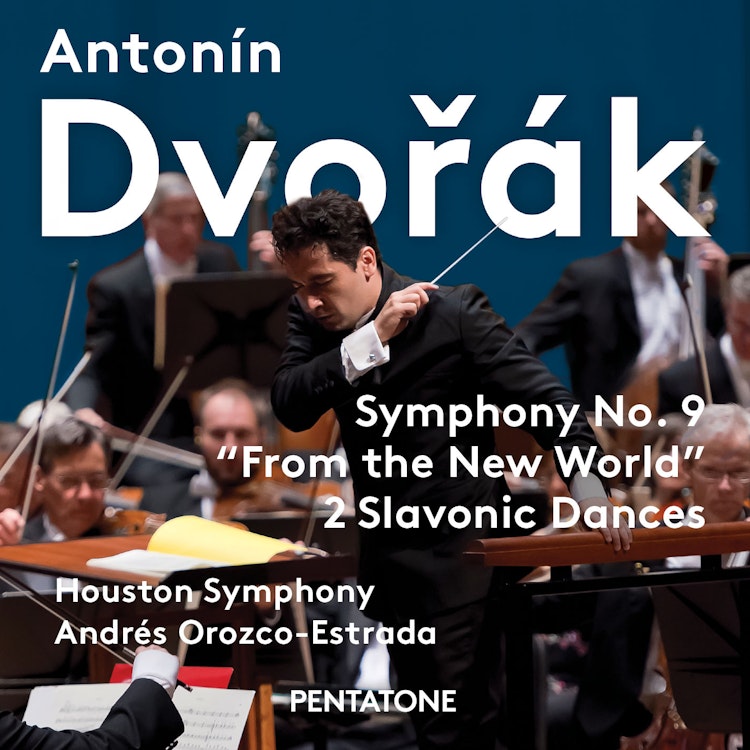
Dvořák: Symphony No. 9 "From the New World" & 2 Slavonic Dances
3/3/2017, 6 Tracks, 54:15
Featuring
Andrés Orozco-Estrada
Houston Symphony
Antonín Dvořák
Did you know?
1/7
Compositional Technique
The Symphony No. 9 features compelling themes that reappear throughout the work, enhancing its cumulative impact, such as the French horn motif from the first movement which recurs in the slow movement, Scherzo, and finale.
Composer's Artistic Vision
Upon arriving in New York to direct the National Conservatory of Music of America, Antonín Dvořák expressed his vision to help young Americans express themselves and establish a new American school of music rooted in its own soil.
Composer Biography
Early in his career, Antonín Dvořák applied for a stipend for needy artists from Austria's culture ministry, which he won, and his works impressed Johannes Brahms, a prestigious member of the judging panel.
Composition History
Dvořák's Symphony No. 9, 'From the New World,' incorporated sketches from an abandoned vocal work based on Henry Wadsworth Longfellow's 'The Song of Hiawatha,' which had captured his imagination in his youth.
Composition History
Johannes Brahms promoted Dvořák's works and recommended him to publisher Fritz Simrock, who then commissioned Dvořák to compose folk-style dances similar to Brahms's successful Hungarian Dances.
Compositional Technique
Instead of borrowing existing folk tunes, Dvořák created original works for his Slavonic Dances based on Czech dance forms.
Performer Biography
Andrés Orozco-Estrada, the conductor, began his musical studies on the violin and started conducting at age 15, later studying at the Vienna Music Academy.
You might also enjoy...
Dvorak, Vol. 2: Slavonic Dances, Op. 72 - Symphony No. 8 in G Major, Op.88
Arnold: 4 Scottish Dances & Symphony No. 3
Smetana: Triumphal Symphony & Overture and Dances from The Bartered Bride
Ballet Music from The Nutcracker, Swan Lake, Sleeping Beauty, and Eugene Onegin
Smetana: Bartered Bride (The) (Excerpts) / String Quartet No. 1, "From My Life" (Arr. for Orchestra)
Symphonie du Nouveau Monde / Valse Slaves
Dvorák: Symphony No. 7 and other works
Dvorák: Symphony No. 7 and other works
Dvorák: Symphony No. 7 & Carnival Overture - Smetana: The Moldau, Bartered Bride and More