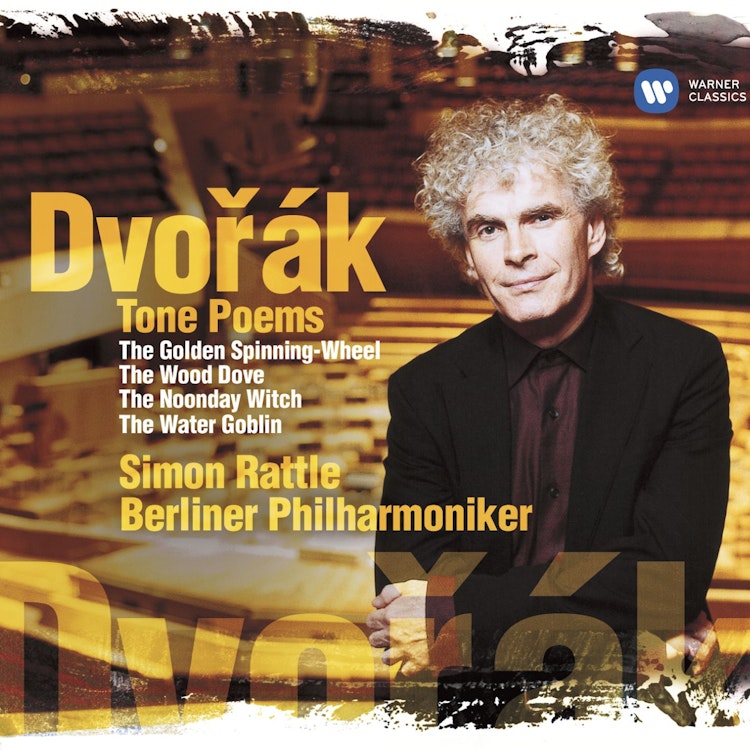
Dvořák: Tone Poems. The Golden Spinning-Wheel, The Wood Dove, The Noon Witch & The Water Goblin
11/25/2005, 15 Tracks, 1:23:46
Featuring
Sir Simon Rattle
Berliner Philharmoniker
Antonín Dvořák
Did you know?
1/7
Composition History
Dvořák began composing three of these symphonic poems — The Water Goblin, The Noonday Witch, and The Golden Spinning-Wheel — almost simultaneously in January 1896, completing them by March.
Compositional Technique
The music of these poems often avoids grimness, instead using a deliberately naive charm and inventing free but expressive formal patterns, with themes directly associated with characters.
Composition History
These 'orchestral ballads' are based on poems by Karel Jaromír Erben, an official archivist of Prague, whose collection A Garland of Folk Poetry (1853) provided the texts.
Composer's Artistic Vision
Dvořák, a patriotic Czech, consciously decided to move away from 'pure' instrumental music to focus on national and dramatic musical expressions in the last decade of his life.
Critical Reception
These orchestral ballads marked a change in Dvořák's style, moving away from Viennese classicism towards a more operatically influenced orchestral style, which was deplored by some classical admirers like Eduard Hanslick.
Composer Biography
Antonín Dvořák, already internationally famous, returned to Bohemia from America in April 1895, dividing his time between Prague and his property at Vysoká.
Compositional Technique
In The Golden Spinning-Wheel, Dvořák molded musical ideas to the rhythms and intonations of Erben's text, creating a unique synthesis of music and unheard words, like an extended song without words.
You might also enjoy...
Liszt: Symphonic Poems
Franz Reiner conducts Rimsky - Korsakov
Liszt: Eine Faust Symphonie (A Faust Symphony), S. 108
Liszt: Eine Symphonie zu Dantes Divina commedia, S. 109 & Tasso. Lamento e trionfo, S. 96
William Wallace: Symphonic Poems
Tchaikovsky: Romeo and Juliet (Fantasy Overture)
Saint-Saëns: Le rouet d'Omphale, symphonic poem, Op. 31
Liszt: Symphonic Poems
Zemlinsky: Die Seejungfrau (After H. Andersen) [Live]
Liszt, F.: Symphonic Poems, Vol. 2 - Faust Symphony / Von Der Wiege Bis Zum Grabe
Loeffler: Memories of My Childhood (Recorded 1936)