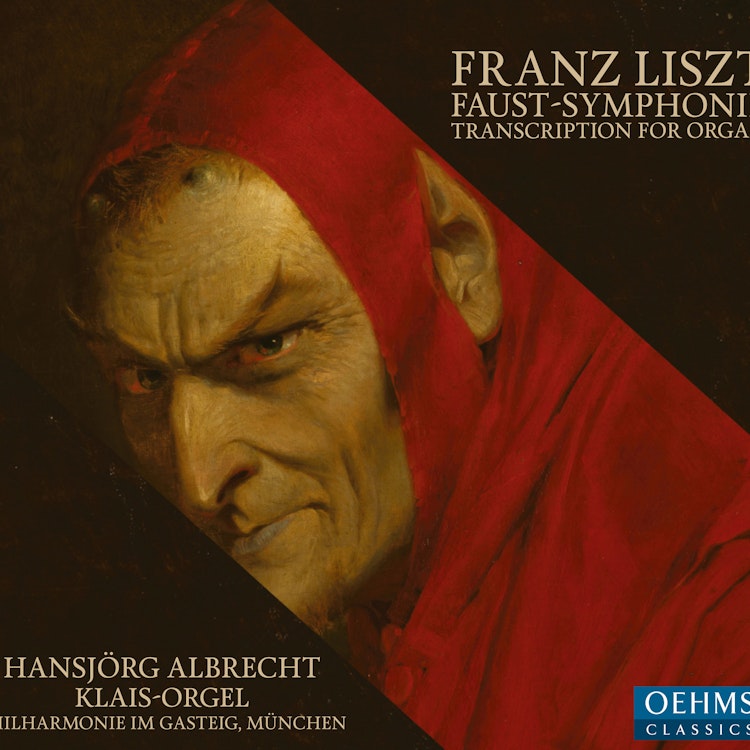
Eine Faust-Symphonie in drei Charakterbildern, S. 108 (1854 Version) [Arr. H. Albrecht for Organ]
7/13/2018, 3 Tracks, 1:09:07
Featuring
Hansjörg Albrecht
Franz Liszt
Did you know?
1/7
Compositional Technique
The Faust Symphony's three main movements are each dedicated to one of Goethe's main characters: Faust, Gretchen, and Mephistopheles, focusing on their characterization rather than the plot.
Composition History
Franz Liszt dedicated his Faust Symphony to Hector Berlioz, who had previously dedicated his own Faust composition, La Damnation, to Liszt.
Critical Reception
While some 19th-century critics like Eduard Hanslick dismissed Liszt's Faust Symphony as 'objectionable music,' Richard Strauss praised it as 'marvellous.'
Composer's Artistic Vision
In Weimar, Liszt developed his understanding of program music and created the symphonic poem genre, aiming to fuse music and literature into a Gesamtkunstwerk.
Composer Biography
Liszt found the time to compose his Faust Symphony in Weimar, the home of Goethe and Schiller, after touring Europe for two decades as a piano virtuoso.
Composition History
The world premiere of Liszt's Faust Symphony was organized for a special occasion: the inauguration of the Goethe and Schiller Monument in Weimar on September 5, 1857.
Compositional Technique
The opening theme of Liszt's Faust Symphony is often considered the first twelve-tone theme in music history, as it features all twelve tones of the chromatic scale.
You might also enjoy...
L'orgue Mystique, Opp. 55-57: No. 31 Dominica Vi Post Pentecosten
L'orgue Mystique, Opp. 55-57: No. 44 Dominica XVII Post Pentecosten
L'orgue Mystique, Opp. 55-57: No. 27 in Festo Corporis Christi
L'orgue Mystique, Opp. 55-57: No. 43 Dominica XVI Post Pentecosten
Cook, J.: The Everlasting Habitations (Organ Music by James Cook)
L'orgue Mystique, Opp. 55-57: No. 41 Dominica XV Post Pentecosten
L'orgue Mystique, Opp. 55-57: No. 3 Nativitas Domini Nostri Jesu Christi
Tournemire: L'Orgue Mystique
L'orgue Mystique, Opp. 55-57: No. 51 Dominica XXIII Post Pentecosten
L'orgue Mystique, Opp. 55-57: No. 48 Festum Omnium Sanctorum
L'orgue Mystique, Opp. 55-57: No. 25 in Festo Pentecostes
Stations of the Cross (Live)
L'orgue Mystique, Opp. 55-57: No. 49 Dominica XXI Post Pentecosten