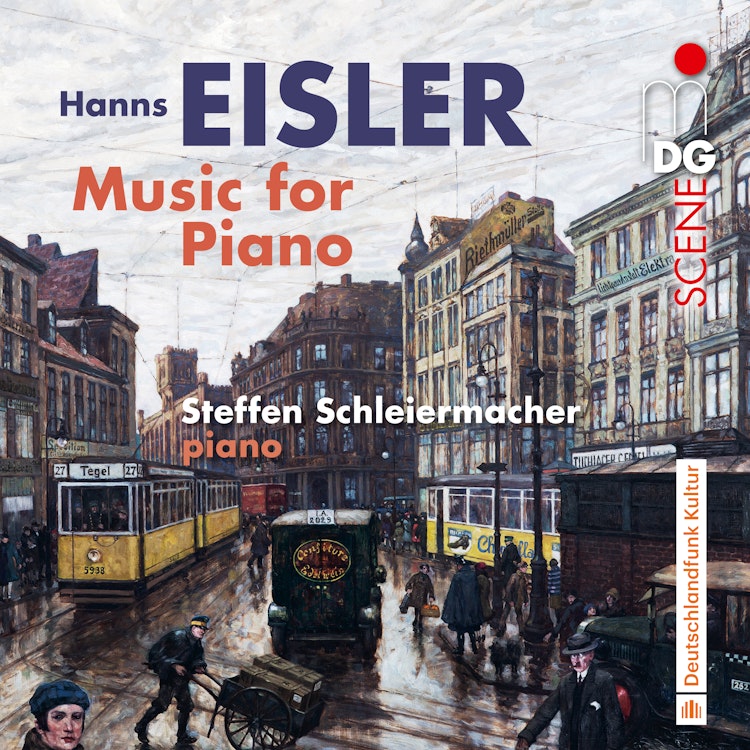
Hanns Eisler, a composer of the Second Viennese School, had an ambivalent relationship with the piano, seeing it as a relic of bourgeois musical culture.
Composer Biography
Eisler dedicated the 'Little Music for Dispelling Sentimental Moods' to Hedi Gutmann, who was known as 'Mrs. Eisler' for several years and later imprisoned in the Siberian Gulag.
Composer's Artistic Vision
For his pedagogical pieces, Eisler believed that music should teach musical logic using progressive new means, not merely reflect private moods or train technical virtuosity.
Compositional Technique
In his Klavierstücke Op. 8, Eisler cunningly arranged pieces to alternate between freely composed and more or less strict twelve-tone pieces.
Compositional Technique
The theme of Eisler's extensive Variations for Piano is a quotation of the famous quintet from Mozart's 'The Magic Flute,' where Papageno is prevented from speaking.
Composition History
Eisler's Piano Sonata No. 2, completed in 1926, was not published by him due to fundamental artistic and aesthetic doubts, and was only premiered in 1958.
Composer's Artistic Vision
Eisler aimed to build a new, socialist musical life where music would be useful, have a character of struggle and education, and serve enjoyment only secondarily.
You might also enjoy...
Busoni: Late Piano Music
Weinberger: Piano Music
Scent of a Dream
Harald Sæverud: The Complete Piano Music
Tcherepnin: 5 Concert Etudes / Gould: Pieces of China / Adams: China Gates
Enescu: Complete Works for Piano Solo
Busoni: 6 Piano Sonatinas, Indianisches Tagebuch I & Toccata
Blomdahl / Lidholm / Bortz: Piano Music
Notations & Sketches
Thomas Pitfield: Piano Music
Langgaard: Piano Works, Vol. 4
Viennese School: Teachers and Followers: Anton Webern
Bowen: Piano Works, Vol. 4
Krenek, E.: Piano Works - 12 Variations in 3 Movements / 11 Piano Pieces / Echoes From Austria / Piano Sonata No. 7