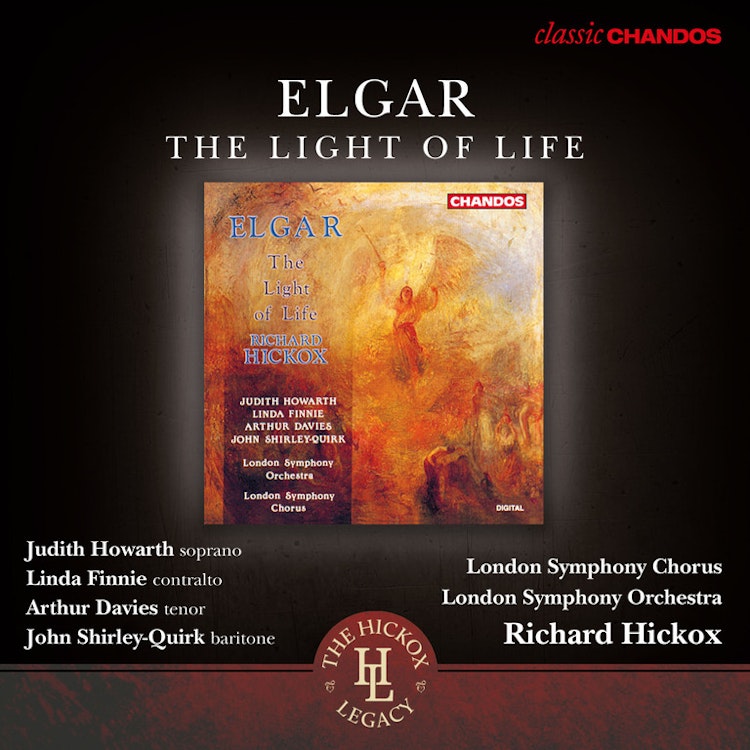
The Light of Life is considered a prelude to Elgar's uncompleted trilogy of New Testament oratorios, sharing themes with The Apostles and The Kingdom, which Elgar said came "from the same oven."
Composition History
The publisher, Novello's, requested that The Light of Life be under an hour in length and suggested changing the original Latin title, Lux Christi, to avoid perceived Roman Catholic bias at an Anglican festival.
Performer Biography
Richard Hickox, the conductor on this recording, was Music Director of Opera Australia and founded the City of London Sinfonia in 1971.
Recording & Production
This recording of Elgar's The Light of Life was made in All Saints' Church, Tooting, from February 1st to 3rd, 1993.
Compositional Technique
Elgar included a fugue in The Light of Life because he believed the British public expected one in an oratorio, though he aimed for a "not a 'barn-door' fugue, but one with an independent accompaniment."
Composition History
Elgar's oratorio, The Light of Life, was commissioned for the Three Choirs Festival at Worcester in 1896, with a libretto based on the story of Christ healing the blind man.
Critical Reception
At its 1896 premiere, The Light of Life was well received, though most criticism was directed at the libretto, with one precentor finding a line in the Mother of the Blind Man's solo "somewhat deficient in reverence."