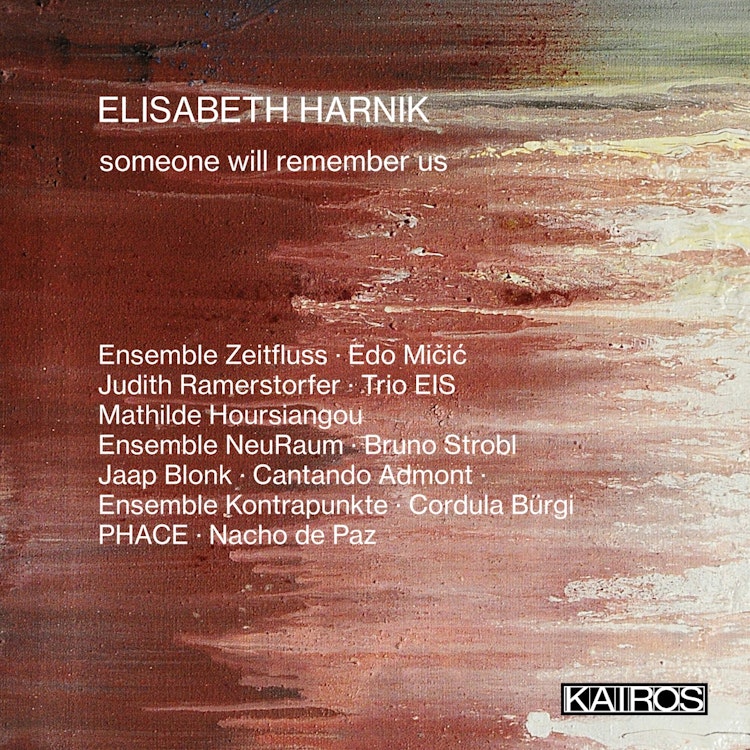
Harnik's music often dedicates works to female artists who serve as role models or milestones in her creative journey, reflecting a feminist perspective.
Compositional Technique
In her piece "of all stars the most beautiful" for piano, Elisabeth Harnik combines improvisation and composition by requiring extended playing techniques inside the piano.
Compositional Technique
The ensemble piece "grafting II" transfers a conducting gesture from orchestral improvisation to composition, allowing the conductor to act as a 'hinge' between conventionally notated parts for flexibility.
Recording & Production
This album features recordings from various venues including Minoritensaal in Graz, marinegrau in Vienna, Radiokulturhaus Wien, Musikverein Wien, and Wiener Konzerthaus.
Composer's Artistic Vision
Harnik's approach to music is deeply influenced by Pauline Oliveros's Deep Listening technique, which she explicitly adopts, understanding musical practice as world-changing.
Composer's Artistic Vision
Elisabeth Harnik views improvisation and composition, typically separate in music, as two sides of the same coin, often using piano preparations and extended techniques in her improvisational playing.
Composer Biography
Elisabeth Harnik, born in Graz in 1970, studied classical piano and later composition with Beat Furrer at the University of Music and Performing Arts, Graz.
You might also enjoy...
Applebaum, M.: 20 / Agitprop / Sum=Parts
Grainger: Transcriptions for Wind Orchestra
John Jenkins: Consort Music For Viols
Ars Nova – New Music
Guerrero, F.: Requiem Mass
Rupert Bawden: The Sailor's Tale, 2 Studies, The Donkey Dances & Beasts of the Sea