Satie's early work, Ogives for piano, already showcased his characteristic frugal use of notes, extremely slow tempi, and seemingly disconnected chords, breaking with traditional musical development.
Performer Biography
Marcel Worms, the pianist on this album, initiated a unique Blues project in 1996, commissioning over 200 composers from more than 50 countries to write works for solo piano.
Composer Biography
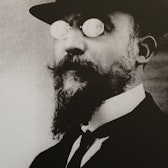
Erik Satie, born Eric Satie, changed the spelling of his first name to 'Erik' in 1884, reflecting his English and Scottish heritage from his London-born mother.
Composer Biography
Satie deliberately contracted pneumonia to be released from military duty, allowing him to begin life as a bohemian, earning a living as a pianist in cabarets like le Chat Noir.
Composer's Artistic Vision
Satie's musical reflections, sometimes published under pseudonyms like Mémoires d'un amnésique, were as unconventional as his music, often blurring genres and challenging historical narratives.
Composer Biography
Satie founded his own Église Métropolitaine d'Art de Jésus Conducteur (Metropolitan Church of Art of Jesus the Conductor), of which he was the sole member, during his religious-mystical period after 1890.
Cultural Impact
Satie's ballet Parade, with a scenario by Jean Cocteau, choreography by Léonide Massine, and designs by Picasso, achieved a succès de scandale due to its energetic, jazz-influenced music and unusual sounds like sirens and typewriters.
You might also enjoy...
Erik Satie: Piano Music
Bartók: Piano Music, Vol. 9
Waltzing Strauss. Johann Strauss Transcriptions for Piano
Liszt, F.: 6 Etudes D'Execution Transcendante D'Apres Paganini / Schubert - Mullerlieder / Verdi - Rigoletto: Paraphrase De Concert
Clara Schumann gewidmet
Miniatures: The Music of Cécile Chaminade
Stravinsky: Complete Music for Solo Piano
Russian Piano Music
Goldstone, A.: Tzigane (A Treasury of Gypsy Inspired Music)