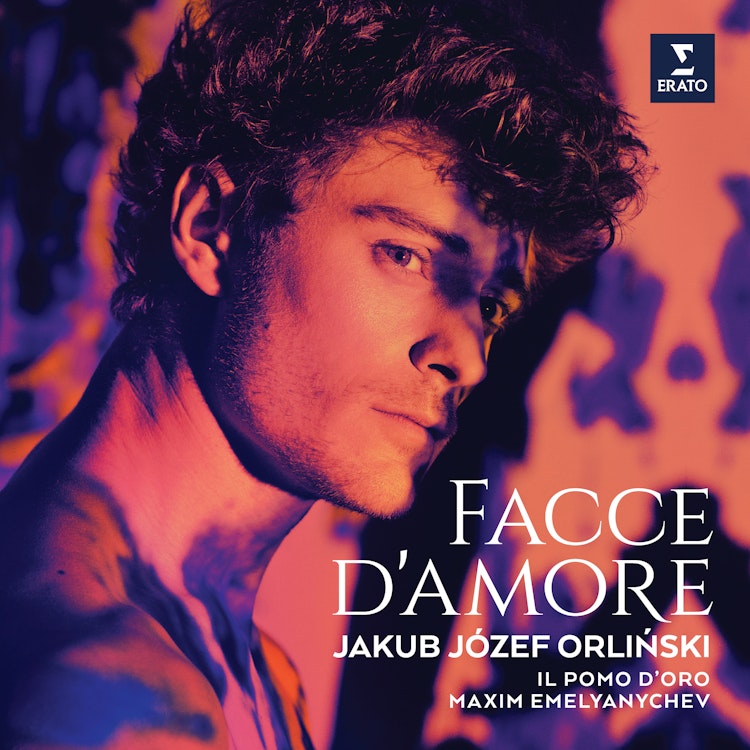
Emerging countertenor Jakub Józef Orliński releases his second album, "Facce d'amore" – faces of love. Orliński sings music from across 85 years of the Baroque period, including eight pieces never before recorded. Il Pomo d'Oro and conductor Maxim Emelyanychev join Orliński for these operatic arias which show the multifaceted nature of love. The repertoire ranges from the familiar to the obscure.
Featuring
Jakub Józef Orliński
Maxim Emelyanychev
Il Pomo d'Oro
Francesco Cavalli
Giovanni Antonio Boretti
Giovanni Maria Bononcini
Giovanni Battista Bononcini
Alessandro Scarlatti
George Frideric Handel
Johann Mattheson
Luca Antonio Predieri
Nicola Matteis
Francesco Bartolomeo Conti
Johann Adolph Hasse
Did you know?
1/7
Historical Context
During the Baroque era, Italian was considered the language of love, even in German cities like Hamburg and Dresden, where deep love arias would switch to Italian.
Recording & Production
This album is Jakub Józef Orliński's second solo album, continuing his collaboration with researcher Yannis François and Il Pomo d'Oro led by Maxim Emelyanychev.
Compositional Technique
Baroque opera composers often highlighted the instruments they themselves played; for example, Francesco Bartolomeo Conti wrote extensively for solo mandolin or theorbo, and Johann Mattheson composed difficult tenor arias because he was a tenor.
Composer's Artistic Vision
The album features composers like Francesco Cavalli, who helped transform opera into entertainment with beautiful melodies and vocal exploration, moving beyond the Greek tragedy focus of earlier opera.
Album & Artwork
The album title, "Facce d'amore" (Faces of Love), reflects its theme of exploring various aspects of love in the Baroque era.
Cultural Impact
Italian dramaturgy and opera were built around the idea of the depth of love, exemplified by the Orpheus myth, where the hero descends to hell to retrieve his beloved.
Historical Context
During this period, musical geography was fluid, with composers traveling to different centers like Italy or Naples to study various styles, making it difficult to determine a composer's origin solely by their style.
You might also enjoy...
Quella Fiamma
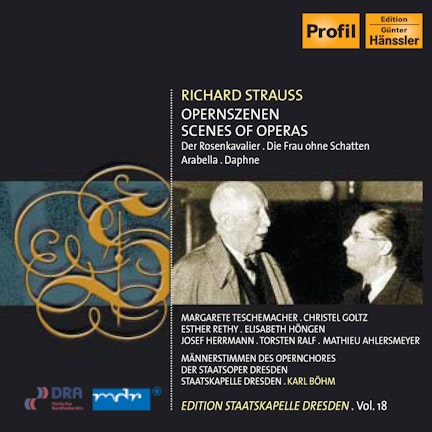
Strauss, R.: Arabella / Der Rosenkavalier / Die Frau Ohne Schatten / Daphne (Excerpts) (Staatskapelle Dresden Edition, Vol. 18)