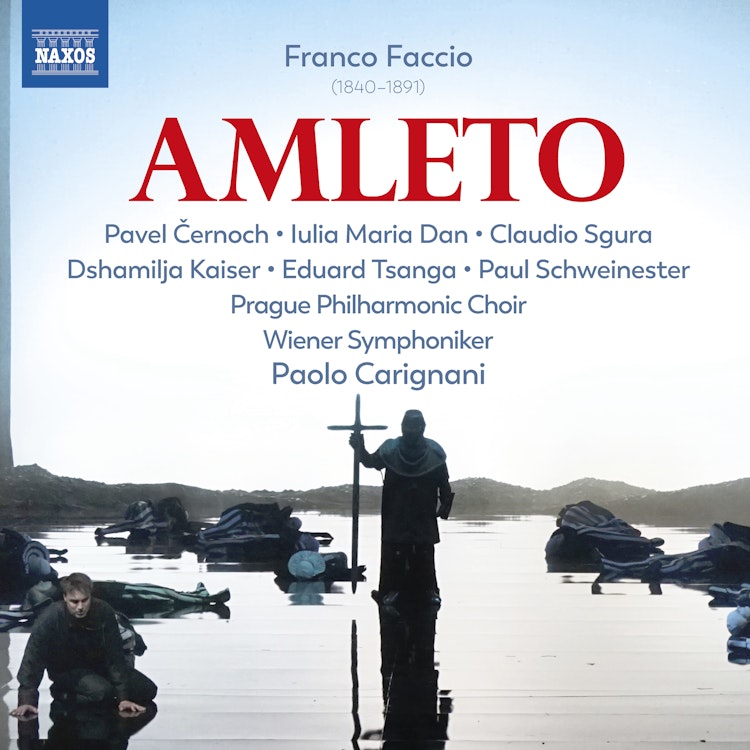
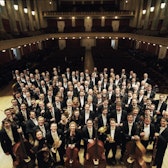
Shakespeare’s Hamlet has inspired many composers over the centuries, but in this opera it inspired two at the same time: Amleto was composed by Franco Faccio (1840-1891) to a libretto by Arrigo Boito (1842-1918), the writer (and composer) better known for collaborating on Verdi’s final operas. Premiered in 1865, Amleto met with mixed reviews and remained little known until recent years, despite its innovations and impressive set pieces. This recording features the Wiener Symphoniker and Prague Philharmonic Choir, with Paolo Carignani conducting a cast that includes Pavel Černoch in the title role.
Featuring
Pavel Černoch
Claudio Sgura
Edward Tsanga
Paul Schweinester
Dshamilja Kaiser
Paolo Carignani
Iulia Maria Dan
Sébastien Soulès
Bartosz Urbanowicz
Gianluca Buratto
Jonathan Winell
Sabine Winter
Yasushi Hirano
Wiener Symphoniker
Prague Philharmonic Choir
Franco Faccio
Did you know?
1/7
Composer Biography
After the disappointing 1871 performance of Amleto, Franco Faccio published no more music and focused on his conducting career, becoming one of the most significant Italian conductors of the 19th century.
Composer's Artistic Vision
Composer Franco Faccio and librettist Arrigo Boito, who both studied at the Milan Conservatory, believed Italian opera needed reinvention and were part of the 'Scapigliatura' artistic movement.
Critical Reception
The reception of Faccio's Amleto was heavily impacted by the illness of the tenor Mario Tiberini at its 1871 La Scala staging, leading the work's publisher to comment: 'Amleto was performed without Hamlet'.
Recording & Production
This recording represents the first complete performance of Franco Faccio's Amleto in Europe since 1871, made possible by American conductor Anthony Barrese's 2007 publication of the score and Elisabeth Sobotka's focus on the work.
Cultural Impact
A part of Faccio's opera Amleto, the sumptuous funeral march for Ophelia, has survived on the Greek island of Corfu and is played annually on Easter Saturday in a version for wind orchestra.
Composition History
Franco Faccio's opera Amleto (Hamlet) was intended to be a prime example of a "nuovo melodramma" or new form of opera, and it premiered in Genoa in 1865.
Compositional Technique
Faccio's Amleto is notable for its faithful adaptation of Shakespeare's original play, a significant departure from earlier Italian operatic versions that often added happy endings.