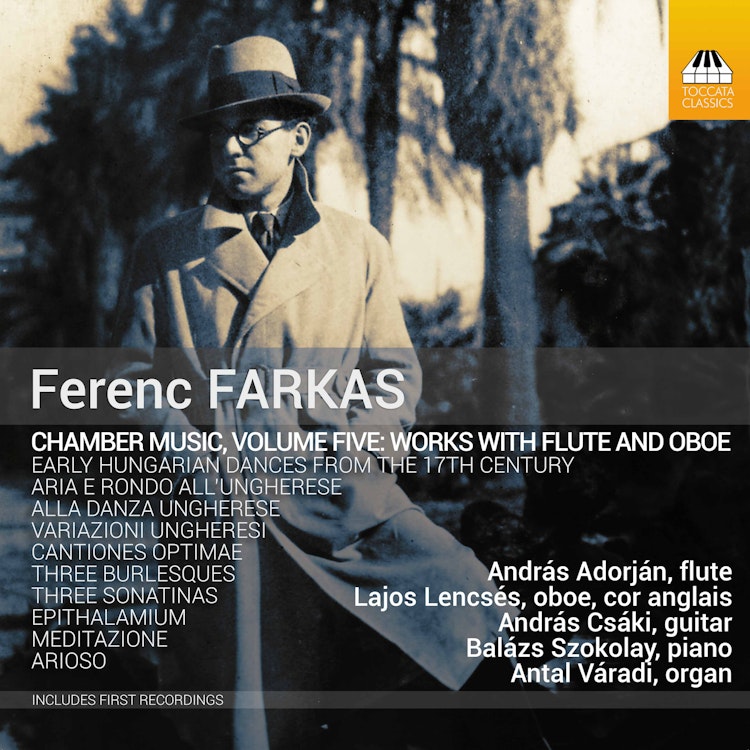
Farkas: Chamber Music, Vol. 5 – Works with Flute & Oboe
7/2/2021, 27 Tracks, 1:16:43
Featuring
András Adorján
Balázs Szokolay
András Csáki
Lajos Lencsés
Antal Váradi
Ferenc Farkas
Did you know?
1/7
Compositional Technique
In the Epithalamium, Farkas embedded the letters of the names of the newly-weds, Françoise and András, into the musical motifs to symbolise their interwoven destiny.
Composition History
The Epithalamium for oboe and organ was composed by Farkas in 1973 for the wedding of his son, András, and its opening performance took place during the marriage ceremony.
Composer's Artistic Vision
Farkas initially avoided folk-music arrangement to develop his own style, drawing inspiration from Italian Neo-Classicism before engaging with Hungarian folk traditions in the mid-1930s.
Composer's Artistic Vision
Farkas was known for his absolute musical conception, where structure and part relationships were more important than specific instrument combinations, allowing his works to be easily adapted.
Composition History
Farkas's Early Hungarian Dances from the 17th Century originated from music he composed for a 1940s Hungarian historical film, Rákóczi nótája ('Rákóczi's Song').
Composer Biography
Ferenc Farkas, the composer, had a long life spanning almost the entire 20th century (1905-2000) and was considered one of Hungary's most knowledgeable composers.
Composer Biography
Ferenc Farkas headed the Composition Department of the Budapest Academy of Music from 1949 to 1975, teaching many major composers of the next generation, including György Ligeti and György Kurtág.
You might also enjoy...
Saint-saëns: Complete Music with Flute
Andersen, J.: Recordings (Complete), Vol. 7 - Works for Flute and Piano
In All Directions: Chamber Music for Flute, Cello and Piano by Michel Merlet
Time Place Spirit - Music for Flute and Piano
Schocker, G.: Healing Music / Once Upon A… / Fountain / The Further Adventures of 2 Flutes / Hannah's Glade
Dvorak / Franck: Violin Sonatas (Arr. for Flute and Piano) / Schubert: Variations On Trockne Blumen
Kronke, Reger & Others: Works for Flute & Piano
Herbiet: Airs & Danses
Clouds Are Not Spheres
Gagik Hovunts: 30 Pieces for Instruments of the Symphony Orchestra and Piano
Cor! Alison Teale Plays Cor Anglais
Moscheles: Music for Flute & Piano
Villa-Lobos: Sexteto místico and other chamber music