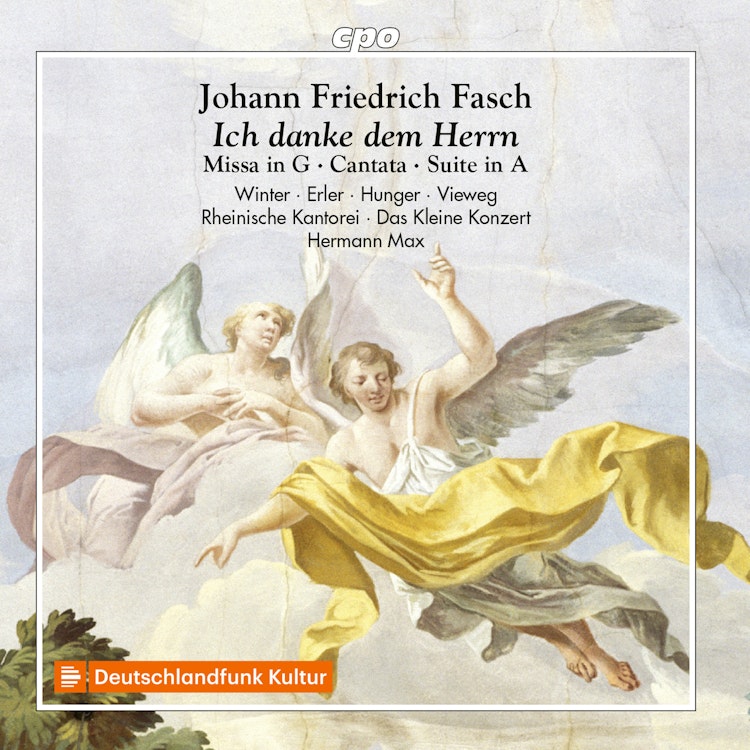
Fasch: Mass in G Major, Overture in A Major, & Ich danke dem Herrn von ganzem Herzen
11/2/2018, 35 Tracks, 1:13:56
Featuring
Hermann Max
Veronika Winter
David Erler
Tobias Hunger
Matthias Vieweg
Das Kleine Konzert
Rheinische Kantorei
Johann Friedrich Fasch
Did you know?
1/7
Composer Biography
Johann Friedrich Fasch, who became Zerbst's court chapel-master in 1722, was directly exposed to ongoing denominational developments like Pietism, requiring him to compose church music for all court services and liturgical feasts.
Composer Biography
Johann Friedrich Fasch stated in his autobiography that he learned almost everything from his friend Georg Philipp Telemann, constantly taking him as a model, especially for overtures.
Performer Biography
Hermann Max, the conductor, is a pivotal figure in historically informed performance, known for tireless research in libraries and archives, creating authentic scores, and ensuring authentic performances.
Composer's Artistic Vision
Fasch composed his cantatas with a mission to prevent listeners from being indifferent to the sung texts, using compositional artifices to capture attention and emphasize important words.
Compositional Technique
In Fasch's cantatas, the opening Bible quotation (dictum) is often sung by a solo soprano instead of the customary chorus, followed by an imposing choral fugue where voices enter successively in canon.
Composition History
Fasch's Missa in G-Dur, performed here, is based on a source that predates his 'study visit' to Dresden, as it does not incorporate modifications made by Johann David Heinichen, director of the Catholic chapel in Dresden.
Historical Context
The town of Zerbst, where Johann Friedrich Fasch worked as court chapel-master, was the first in Anhalt to adopt the Reformation, with Martin Luther preaching there in 1522.
You might also enjoy...
Fasch: Cantatas
Vejvanovksy: Messe / Motetten / Orchesterweke
Subissati: Violin sonatas
Gulda Meets Shostakovich
Myth, Legend, Romance
Arias for Silvio Garghetti
Rudolf Friml: Chansonette
Il Canto della Sirena: Cantate Napoletane dell'Eta Barocca