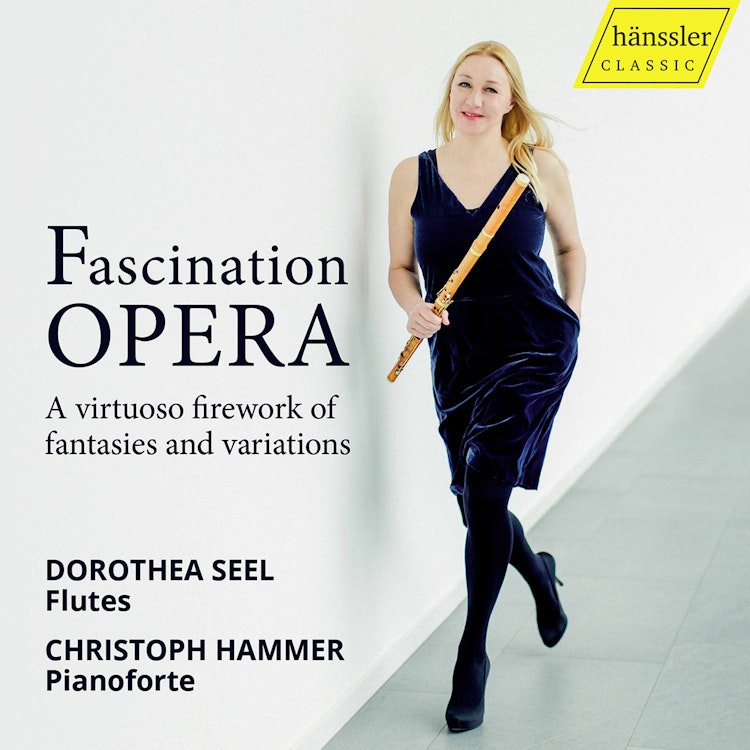
Fascination Opera: A Virtuoso Firework of Fantasies & Variations
4/17/2020, 8 Tracks, 1:13:34
Featuring
Dorothea Seel
Christoph Hammer
Raffaello Galli
Jules Herman
Giulio Briccialdi
Moritz Fürstenau
Friedrich Kuhlau
Carl Joachim Andersen
Theobald Böhm
Wilhelm Popp
Did you know?
1/7
Historical Context
19th-century opera arrangements for flute and piano, though largely ignored by music historians, played a prominent role in the performing practice of the period.
Recording & Production
A significant challenge in this recording was balancing the fortepiano, tuned to a' = 430 Hz, with the three historical flutes, which had varying pitches of 460 Hz, 438 Hz, and 433 Hz.
Performer Biography
Christoph Hammer, the pianist, is an internationally recognized musician in historical performance practice and has conducted numerous opera productions and premiere recordings.
Performer Biography
Dorothea Seel, the flautist, is a specialist in 18th and 19th-century transverse flutes and is the artistic director of the Barocksolisten München.
Interpretation
This recording uses three different historical flutes to reproduce the diverse flute sounds of the 19th century, allowing for subtle differences in tone color.
Instruments
The conical ring-key flute, used on this recording, was invented by the famous flute maker Theobald Boehm in 1832, 15 years before his well-known cylindrical silver flute.
Interpretation
The recording features a Conrad Graf grand fortepiano from 1835, which has four pedals, including two 'moderators' that create a muted, silvery sound by placing cloth between the hammer and strings.
You might also enjoy...
Gary Schocker: Flute Sonatas
F. & K. Doppler: The Complete Flute Music, Vol. 2
Russian Dreams: Music for Flute and Piano
The Iridescent Flute
Doppler and Kuhlau: Romantic and Virtuoso Music for Flutes and Piano
Flauta Andina: 20th Century Music for Flute & Piano
Poulenc - Hindemith - Dutilleux - Muczynski - Martin