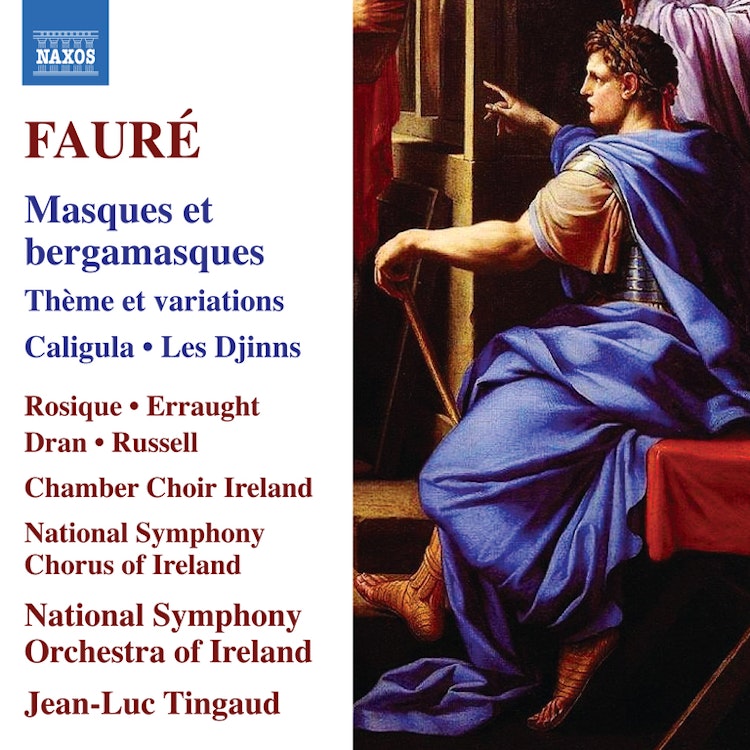
Fauré: Masques et bergamasques, Thème et variations, Caligula & Les Djinns
3/28/2025, 15 Tracks, 1:02:09
Featuring
Jean-Luc Tingaud
Benjamin Russell
Julien Dran
Ruth Rosique
Tara Erraught
RTÉ Philharmonic Choir
RTÉ National Symphony Orchestra
Chamber Choir Ireland
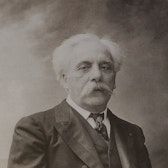
Gabriel Fauré
Did you know?
1/7
Composition History
As a busy professional musician, Fauré often reused pieces or individual movements in different contexts, a practice evident in works like Masques et bergamasques.
Composer's Artistic Vision
Fauré's best-known works, the Requiem and Pavane, are not typical of his output, which largely focused on solo piano pieces, songs, and chamber music, often performed in aristocratic salons.
Compositional Technique
The incidental music for Caligula focuses on the lives and feelings of the women of the court, rather than the emperor, with an exception in the first act's military fanfare.
Composition History
Caligula, Fauré's first venture into incidental music, was composed for a revival of Alexandre Dumas père's 1837 tragedy and premiered in Paris in 1888.
Composition History
Masques et bergamasques, a theatrical divertissement commissioned by Prince Albert I of Monaco, combines newly composed material with music from all periods of Fauré's career.
Composer Biography
Gabriel Fauré, despite his provincial origins, became a professor of composition at the Paris Conservatoire in 1896 and its director in 1905, where he modernized the curriculum.
Recording & Production
This album includes the world premiere recording of Désiré-Émile Inghelbrecht's 1955 orchestral arrangement of Fauré's largest piano work, Thème et variations.
You might also enjoy...
Schubert: Symphony No. 8, D. 759 "Unfinished" & Entracte from Rosamunde
Sibelius: Orchestral Works (Live)
Neeme Jarvi conducts Chabrier
Sibelius: Belshazzar's Feast & Other Orchestral Pieces
Stenhammar: Symphonies Nos. 1 and 2 / Piano Concertos Nos. 1 and 2 / Orchestral Music
Saint-Saëns: Samson and Delilah Fantasy, La Jota Aragonese, Tarantelle