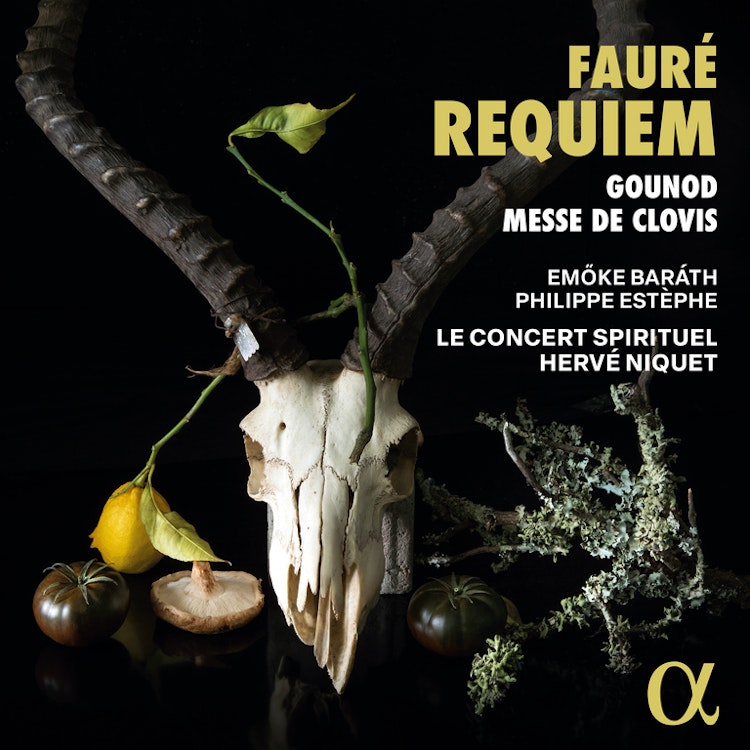
Fauré's Requiem is notable for its original structure, departing from the usual sequence of the Requiem Mass by omitting the Gradual, Prose (Dies Irae), and Benedictus.
Historical Context
After the French Revolutionary period, the restoration of religious worship in 1803 led to a renewal of sacred music in France, initially driven by Napoleon's Chapel.
Recording & Production
This recording of Fauré's Requiem features the 1893 orchestration, which excludes violins and woodwind, as opposed to the later version for full orchestra.
Composer's Artistic Vision
Around 1870, the dramatic and spectacular style in French sacred music gave way to a more ethereal mood, favoring a return to simple purity inspired by Gregorian chant and Renaissance motets.
Composition History
Gounod's Messe de Clovis, composed in 1891 and published posthumously in 1896, was written for the 14th centenary of Clovis's baptism in Reims.
Compositional Technique
Gounod's Messe de Clovis revives a 'neo-Palestrinian' style, drawing inspiration from Palestrina and neo-Renaissance writing, though the claim of being 'in the style of Gregorian chant' is considered an overstatement.
Composition History
Fauré's Requiem, first performed in an incomplete version in 1888, was written shortly after the death of both his parents.
You might also enjoy...
Ohana : Collected Works [The Erato Recordings]
A Tudor Christmas
Tomkins: Anthems & Canticles
Noel
Elegy
The Theatre Of Voices
Gibbons, O.: Anthems / Instrumental Music
Es Ist Ein Ros' Entsprungen
Collaborations
Duruflé: Choral Works
Sacred: Inspirational and Spiritual Music for Choir and Orchestra