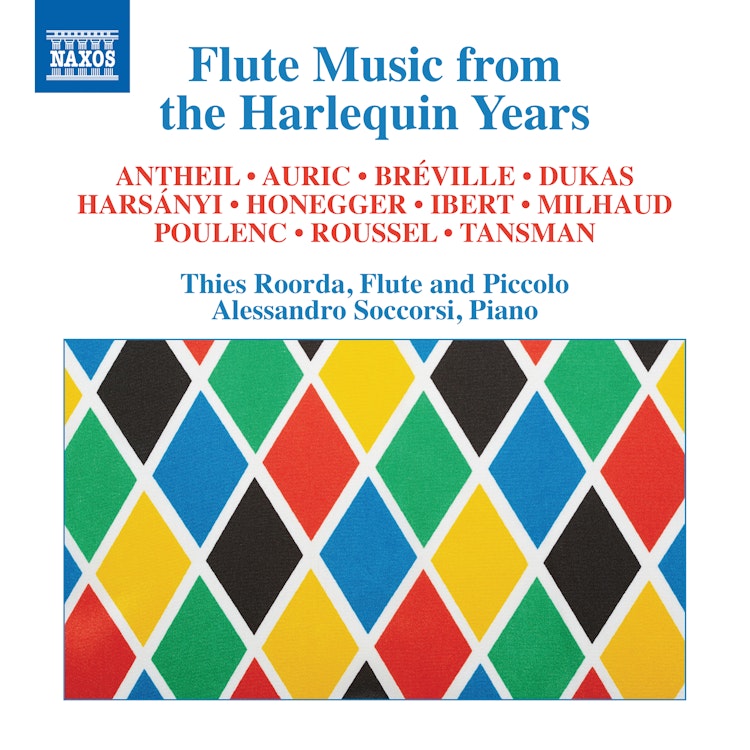
The new musical aesthetic of the "Harlequin Years" embraced simplicity, everyday life, and influences from the circus, music hall, and jazz, leading to bitonality, polytonality, and a hankering after old modes.
Album & Artwork
This album, titled "Flute Music from the Harlequin Years," is inspired by the book "The Harlequin Years" by Nichols, presenting works from a turbulent period in French music.
Historical Context
The pamphlet "Le Coq et l'Arlequin" by Jean Cocteau, published in 1918, advocated for a new, simpler, and authentically French music, rejecting both Wagnerian Romanticism and Debussy's Impressionism.
Historical Context
The First World War led to a re-evaluation of social and cultural norms, prompting composers like Albert Roussel and Maurice Ravel to seek radical change and a "denuded style" in their music.
Performer Biography
Thies Roorda, the flutist on this album, had a long orchestral career with the Netherlands Radio Philharmonic Orchestra before dedicating himself to specific periods of flute repertoire, and has had works dedicated to him by composers like Jean Françaix.
Historical Context
Many foreign composers, including Aaron Copland, Walter Piston, Heitor Villa-Lobos, Manuel de Falla, George Antheil, Quincy Porter, Alexandre Tansman, Bohuslav Martinů, and Alfredo Casella, studied or worked in Paris in the 1920s, engaging with these new musical ideas.
Recording & Production
Several pieces on this album, including Pierre de Bréville's "Une flûte dans les vergers," Arthur Honegger's "Vocalise-Étude" (in an arrangement for flute and piano), and Tibor Harsányi's "3 Pièces for piano and flute," are world premiere recordings.
You might also enjoy...
Jolivet: Complete Flute Music, Vol. 2
Latin American & Spanish Masterpieces for Flute & Piano
Allen Brings: Chamber Works
Messiaen: Chamber Music
Togni, C.: 3 Studies On Morts Sans Sepulture / Flute Sonata / Violin Sonata / String Trio (Ex Novo Ensemble)
Schubert-Ellington
James Cohn - Sonatas and Chamber Music
Schubert, F.: Lieder (Arr. for Flute and Piano)
A Little Tango in Her Blood
Takemitsu: Garden Rain
Lifchitz, M.: 3 Songs / Revueltas, S.: 5 Canciones Para Ninos / Appledorn, M.J. Van: Passages I and Ii / Kessner, D.: 2 Visions
Chamber Music (Finnish): Century of Finnish Chamber Music (A)
Flute Recital: Bailey, Don - Muczynski, R. / Boulanger, L. / Ravel, M. / Poulenc, F. / Martinu, B. / Hoover, K. / Gieseking, W.
Musik für die Welt von Morgen I - Komponistinnen im Portrait