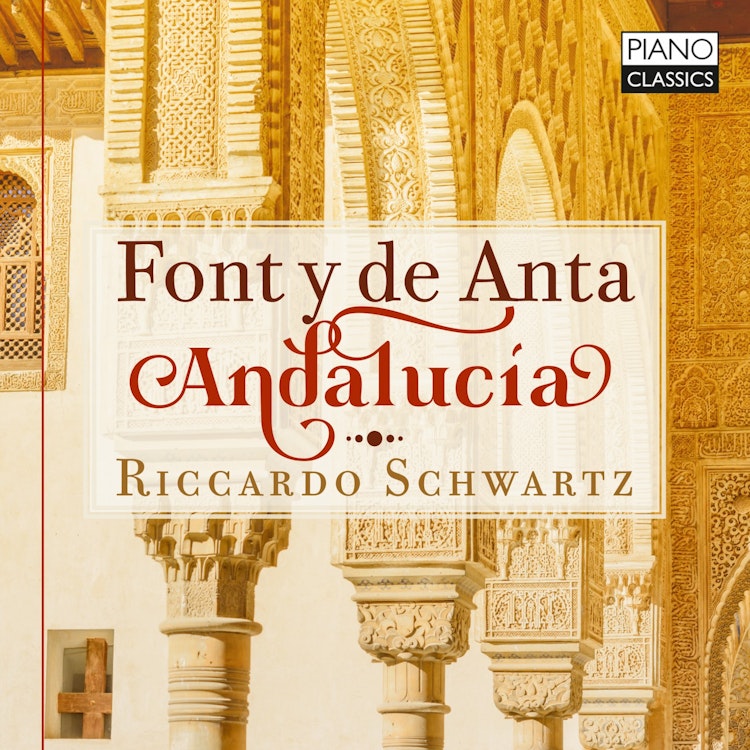
Manuel Font y de Anta's 'Andalucía' is considered one of the three major poetical cycles of Spanish piano literature, alongside Isaac Albéniz's 'Iberia' and Enrique Granados's 'Goyescas'.
Compositional Technique
The 'Andalucía' cycle uses elements of Spanish tradition and folklore, such as dance, singing, and guitar sounds, to create a tribute to the region of Andalucía.
Recording & Production
This recording of Manuel Font y de Anta's 'Andalucía' is its world premiere, bringing this piano cycle to public attention for the first time.
Composition History
Most pieces in Manuel Font y de Anta's 'Andalucía' were written abroad between 1913 and 1914, with two later pieces from 1918 and 1921, reflecting nostalgia for his homeland.
Composer's Artistic Vision
The titles of the pieces in 'Andalucía' evoke neighborhoods and cities of Andalucía, but also convey Manuel Font y de Anta's profound vision of human nature and its aspirations.
Composer's Artistic Vision
The three 'Cuadernos' (notebooks) of 'Andalucía' are sequenced to evoke a hot summer day, progressing from morning (first Cuaderno) through afternoon (second Cuaderno) to evening (third Cuaderno).
Performer Biography
Riccardo Schwartz, the pianist on this recording, was described by conductor Gustav Kuhn as a 'pure talent with an uncanny quest and research for the most subtle beauty' in 2006.
You might also enjoy...
Łukaszewski: Piano Works
Statkowski: Piano Music
McCright, Matthew: Second Childhood
Panorama Argentino
Goldenweiser, A.: Piano Music, Vol. 1
From the Unforgetting Skies
Dodgson: Sonatas Volume 2
R. Schumann: Orchestral and Chamber Works Arranged for Piano 4 Hands, Vol. 5