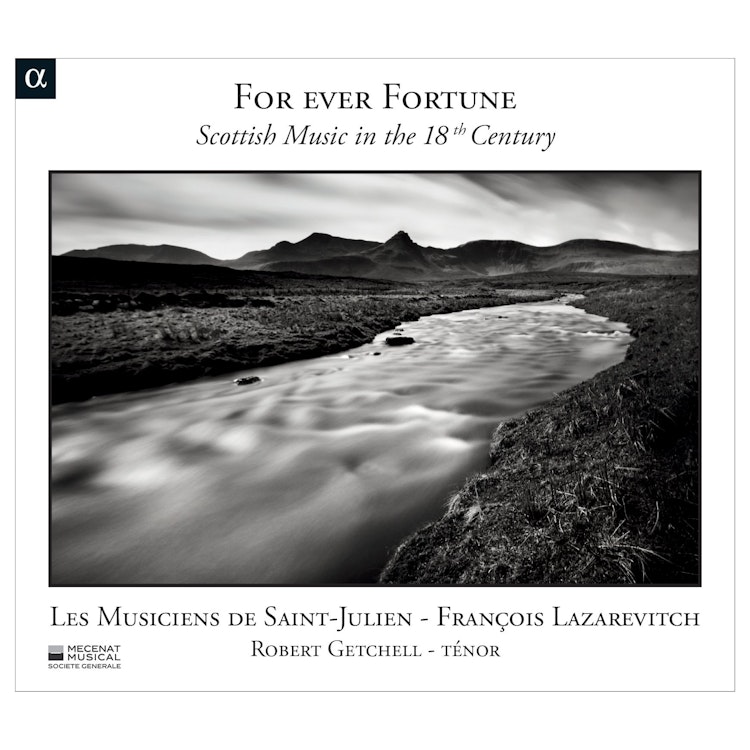
For Ever Fortune: Scottish Music in the 18th Century
4/1/2013, 20 Tracks, 1:06:03
Featuring
François Lazarevitch
Robert Getchell
Les Musiciens de Saint-Julien
William Thomson
James Oswald
Domhnall Bàn MacCrimmon
Niel Gow
Turlough O'Carolan
Anonymous
William Christie
Anonymous (Traditional)
Did you know?
1/7
Recording & Production
This album was recorded in May 2011 in Paris, at the chapel of the Hôpital Notre-Dame de Bon-Secours.
Instruments
18th-century Scots purchased the finest Italian violins and also produced excellent local instruments, while re-tuning fiddles to imitate bagpipes.
Compositional Technique
Scottish composers incorporated traditional dance forms into their sonatas and used techniques like scordatura (re-tuning the violin) to achieve drone effects and increased resonance.
Historical Context
18th-century Scottish music uniquely blended traditional and classical styles, with composers like William McGibbon and James Oswald adapting folk music to Rococo forms.
Composer's Artistic Vision
Scottish composers like Alexander Munro and James Oswald aimed to refresh European culture by drawing on their own traditional music, aligning with Rousseau's vision of pastoral purity.
Cultural Impact
Scottish traditional music was promoted across social strata, from humble audiences to the aristocracy, reflecting a strong sense of social equality in Scotland.
Composer Biography
James Oswald, a Scottish composer, rose from being a dancing master and the son of a frequently jailed town drummer to become Chamber Composer to King George III.
You might also enjoy...
Operatic Arias & Neapolitan Songs
Baroque Concertos
Bravura
Stravinksy: Les Noces ("The Wedding") and Russian Village Wedding Songs
Opera Arias and Melodies. Milano 1902-1904
O amor brazileiro: Modinhas & lundus do Brasil
Weill: Die Dreigroschenoper, Aufstieg und Fall der Stadt Mahagonny & Songs (Recorded 1928-1944)