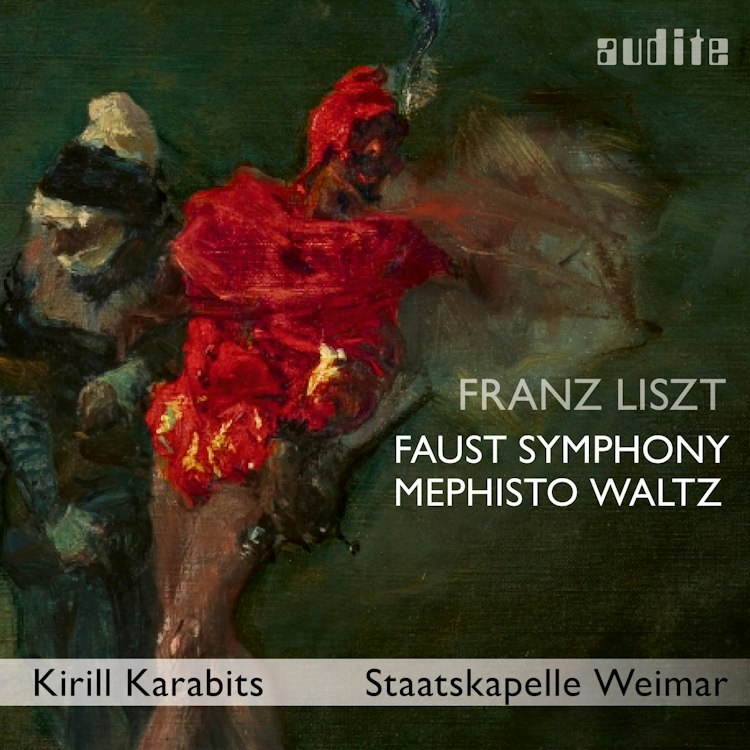
Franz Liszt: A Faust Symphony & Mephisto Waltz No. 3
8/4/2023, 6 Tracks, 1:35:36
Featuring
Kirill Karabits
Airam Hernández
Staatskapelle Weimar
Weimar Deutsches Nationaltheater Opera Chorus
Landesjugendchor Thüringen
Franz Liszt
Boris Mikolayovich Lyatoshinsky
Did you know?
1/7
Compositional Technique
The Faust Symphony's opening motif uses twelve notes of the chromatic scale, which has been seen as a prefiguration of dodecaphony.
Recording & Production
This album includes premiere recordings of the Mephisto Waltz No. 3, arranged for orchestra by Alfred Reisenauer and Kirill Karabits.
Composition History
Liszt's Faust Symphony was completed in its first version in 1854, with the concluding Chorus mysticus added in 1857.
Performer Biography
The Staatskapelle Weimar, founded in 1491, is one of the oldest orchestras in Germany and has a history associated with musicians like Johann Sebastian Bach, Franz Liszt, and Richard Strauss.
Performer Biography
Airam Hernández, the tenor on this recording, is a former French horn player who graduated with honors in vocal studies and two master's degrees from Conservatori del Liceu of Barcelona.
Composer's Artistic Vision
Liszt's "sole ambition" as a composer was the "renewal of music through its more intimate connection with poetry," as exemplified by his Faust Symphony.
Compositional Technique
In the Mephistopheles movement, Liszt cleverly gives the character no original theme, instead using transformed themes from Faust and Gretchen to show Mephistopheles taking possession of their souls.