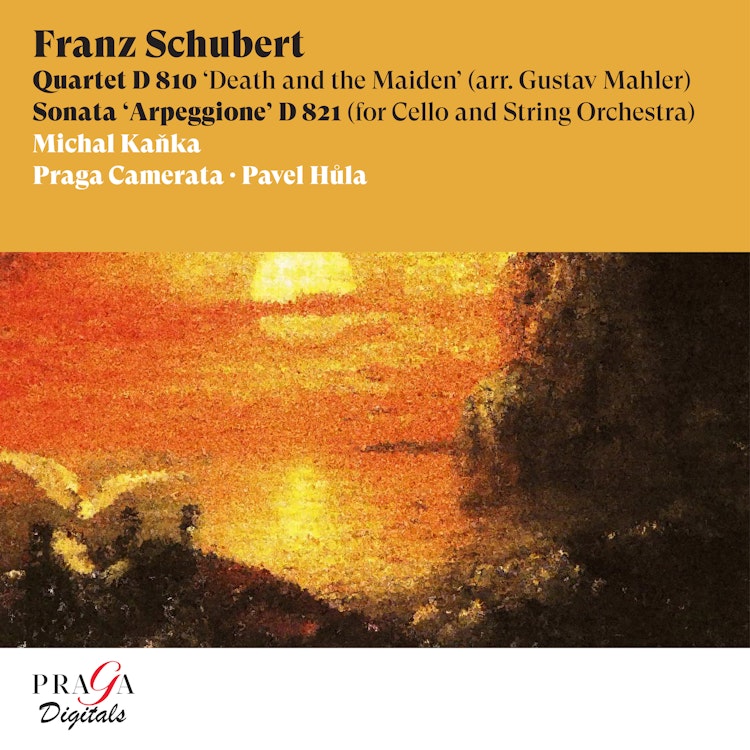
Franz Schubert: Quartet, D. 810 "Death and the Maiden", Sonata Arpeggione, D. 821
10/1/2007, 7 Tracks, 1:06:43
Featuring
Pavel Hůla
Petr Bernášek
Michal Kaňka
Praga Camerata
Franz Schubert
Did you know?
1/7
Notable Performances
The first complete performance of Mahler's string orchestra arrangement of Schubert's 'Death and the Maiden' Quartet took place in 1984 at Carnegie Hall, New York, conducted by Moshe Atzmon.
Composition History
Gustav Mahler's arrangement of Schubert's 'Death and the Maiden' Quartet for string orchestra was reconstructed from pencil annotations found in his daughter Anna Mahler's copy of Schubert's quartets.
Composer's Artistic Vision
Gustav Mahler believed that Schubert's 'Death and the Maiden' Quartet and Beethoven's Opus 95 lacked fullness, and only expanding them to string orchestra could give them their full power and profound life.
Performer Biography
Michal Kaňka, the cellist on this recording, plays an instrument made in 1777 by Paulus Castello of Genoa.
Interpretation
Michal Kaňka's version of the 'Arpeggione' Sonata for cello and string orchestra aims for a concertante and da camera approach, highlighting the cello's pure, timeless melody.
Composition History
Schubert composed his only work for the arpeggione, the 'Arpeggione' Sonata, in 1824 for the eminent performer Vincenz Schuster, who also published a tutor for the instrument.
Instruments
The arpeggione, for which Schubert's 'Arpeggione' Sonata was written, was a six-stringed instrument invented in 1823 by Johann Georg Stauffer, tuned like a guitar but played with a bow like a viola da gamba.
You might also enjoy...
Glinka, Tchaikovsky & Mussorgsky: Works for Chamber Orchestra (Live)