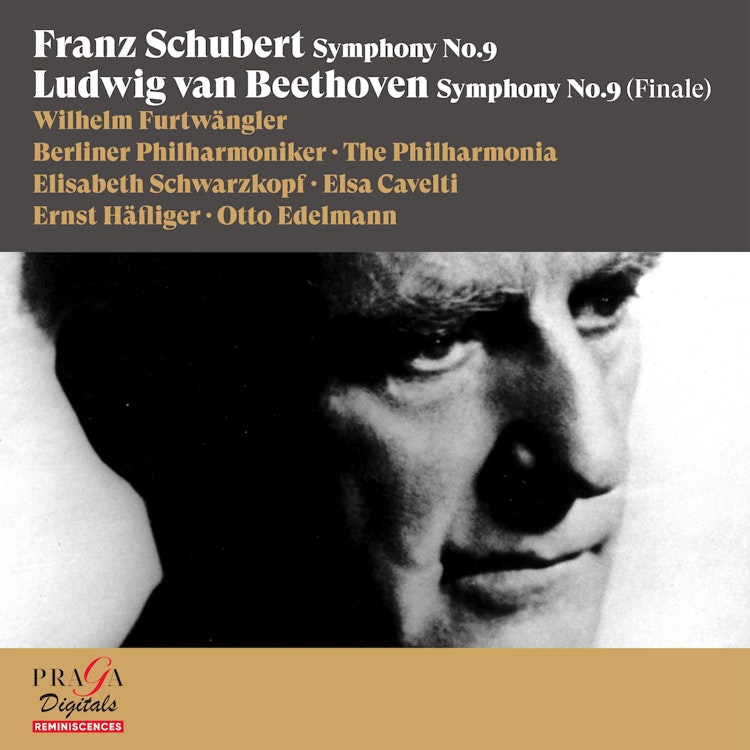
Franz Schubert: Symphony No. 9 - Ludwig van Beethoven: Symphony No. 9 (Finale)
10/1/2015, 5 Tracks, 1:19:27
Featuring
Wilhelm Furtwängler
Elisabeth Schwarzkopf
Elsa Cavelti
Ernst Haefliger
Otto Edelmann
Berliner Philharmoniker
Philharmonia Orchestra
Lucerne Festival Chorus
Franz Schubert
Ludwig van Beethoven
Did you know?
1/7
Interpretation
Wilhelm Furtwängler believed that an interpreter must make music live through rigorous preparation and understanding, allowing for a small part of improvisation to keep the work alive and unique in each performance.
Compositional Technique
Unlike Beethoven, who used trombones sparingly, Schubert's Symphony No. 9 features trombones as essential members of the orchestra, playing throughout the piece and even having important melodic roles.
Performer Biography
During World War II, Wilhelm Furtwängler remained in Germany to defend German music, a stance he described as apolitical, but he later fled to Switzerland due to pressure from the Gestapo.
Performer Biography
Wilhelm Furtwängler, the conductor on this album, was the son of archaeologist Adolf Furtwängler and grew up in a humanistically influenced home in Munich.
Critical Reception
Schubert's Symphony No. 9 was initially considered too long and difficult for amateur orchestras, and its public premiere was delayed until 1839, conducted by Felix Mendelssohn.
Performer Biography
Wilhelm Furtwängler became the director of the Leipzig Gewandhaus Orchestra and the Berlin Philharmonic Orchestra in 1922, succeeding Arthur Nikisch.
Composition History
Schubert's Symphony No. 9, 'The Great,' was largely composed in sketch in the summer of 1825, not in his final year as previously believed.
You might also enjoy...
Lorin Mazel conducts Schubert
Franz Schubert.: Symphony No. 5 / Robert Schumann: Symphony No. 1 (Schreier Konwitschny)
Schubert: Symphonies Nos. 1 & 4, 'Tragic'
Schubert: Sinfonie No. 8 "Die Große"
Schubert: Symphony No. 9 in C major, 'The Great', D. 944
Schubert, F.: Symphony No. 9
A Portrait, Vol. 1: Jascha Horenstein (Remastered 2022) [Live]
Beethoven: Symphony No. 9 in D Minor, Op. 125 "Choral"