The 19th century, influenced by works like Novalis's 'Hymns to the Night', saw the nocturnal world become a rich source of inspiration in literature, art, and music.
Composition History
The musical genre of the 'nocturne' for piano, pioneered by John Field, evolved from outdoor serenades to become an emblematic form for the Romantic salon, reflecting the artist's inner life.
Instruments
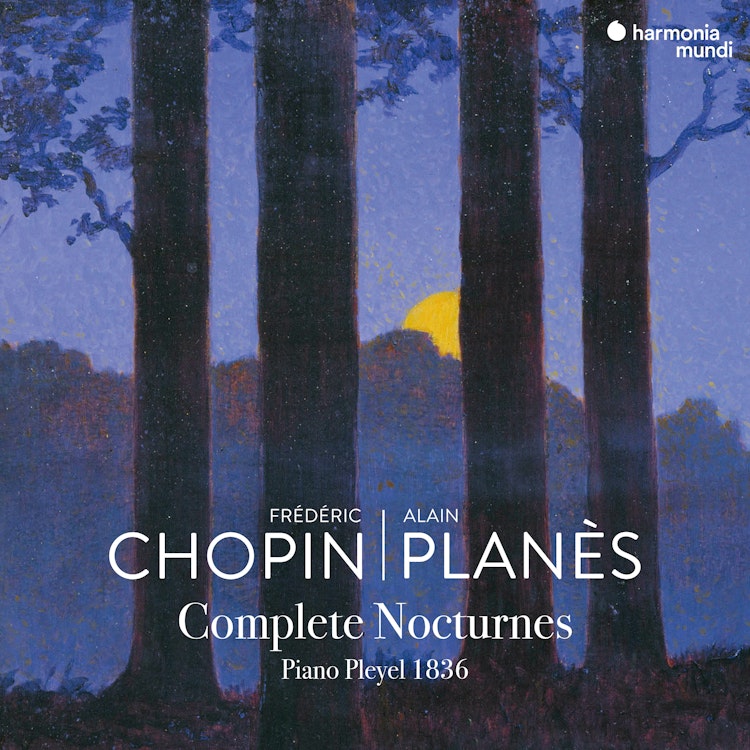
The album features an 1836 Pleyel concert grand piano, a 'Modèle puissant' larger than standard models, with a Brazilian rosewood case and an 80-note keyboard.
Composer's Artistic Vision
Chopin, though generally hostile to program music, sometimes left comments about his inspiration, such as initially titling an Op. 15 Nocturne 'After a performance of Hamlet' before changing it to 'Let them guess for themselves.'
Instruments
The 1836 Pleyel piano used for this recording has three distinct registers: a light, harp-like treble, a velvety middle, and powerful, clear bass notes, which blend better than on modern pianos.
Compositional Technique
Chopin's Nocturnes are characterized by a free, singing melody in the right hand, often deployed over an accompaniment of undulating arpeggios or chords in the left, embodying a 'singing piano' style influenced by Italian bel canto.
Instruments
This Pleyel piano, nicknamed 'Grand Patron', was designed with a new sound production principle, featuring a soundboard made of pine glued to a mahogany layer with perpendicular wood grains, which doubled its volume.
You might also enjoy...
Chopin: The Nocturnes
Chopin : Nocturnes
Chopin, F.: Nocturnes Nos. 1-21
Chopin: 12 Nocturnes for Piano (Digitally Remastered)