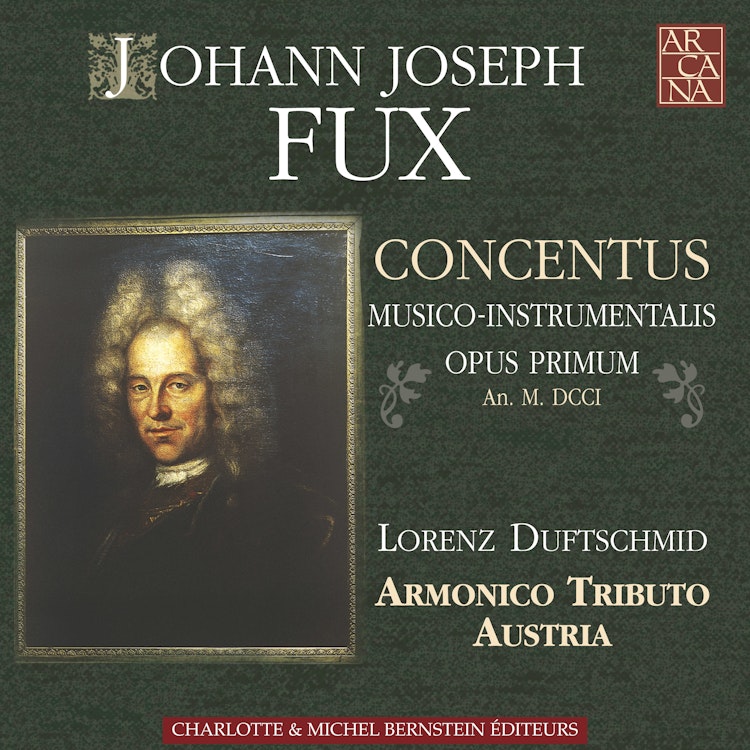
Fux's Ouverture E.109 is notable for its deviation from the usual unity of key, contrasting D minor with F major, B flat major, and D major in different movements.
Composer Biography
Fux's decision to become a musician instead of a priest was marked by his secret departure from the Jesuit university of Ingolstadt in 1683, noted as 'profugit clam' in registers.
Composer Biography
Johann Joseph Fux, an Austrian composer, was born in 1660 into a peasant family, which explains the lack of early written documents about his life.
Composition History
The collection Concentus musico-instrumentalis, dedicated to Emperor Joseph I, was likely financed by him and served as a musical counterpart to the triumphal arches erected for his marriage.
Critical Reception
Fux's music has been long underestimated and perceived as 'dry' due to the widespread influence of his theoretical treatise, Gradus ad Parnassum.
Recording & Production
This recording features a free arrangement of instrumental pieces depicting the Turkish occupation of Vienna in 1683, including the use of period Turkish percussion instruments like a carillon.
Composer's Artistic Vision
Fux's composition treatise advocated for giving more weight to the composer's wishes and reducing the performer's liberties, preceding Gluck in this area.