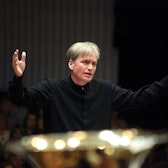
The St Petersburg Philharmonic Symphony Orchestra, founded in 1931 as the Leningrad Radio Orchestra, was the only orchestra to remain in the besieged city during World War II.
Compositional Technique
Gavrilin's 'The Russian Notebook' features unexpected harmonies, acute modulations, polyrhythms, polymetry, and detailed polyphonic processing, which were daring for Russian music in the 1960s.
Composer's Artistic Vision
Gavrilin's compositional style is known for its individualistic aesthetics, beauty, appeal, and bright ethnic color.
Composer Biography
Valery Gavrilin, a Russian composer, lost his father in World War II and was placed in a children's home after his mother was imprisoned.
Composition History
Gavrilin's 'The Russian Notebook' was unexpected due to its high level of classical compositional maturity for a young composer and its unusual musical language, folklore texts, and vocal/piano parts.
Composition History
The ballet 'Anyuta' was initially conceived as a television film based on Chekhov's stories, but its concept shifted to music after the director heard a waltz by Valery Gavrilin.
Composer's Artistic Vision
Gavrilin described 'The Russian Notebook' as 'reminiscence songs' based on folk texts he collected himself, aiming to reveal utmost emotions and frankness.