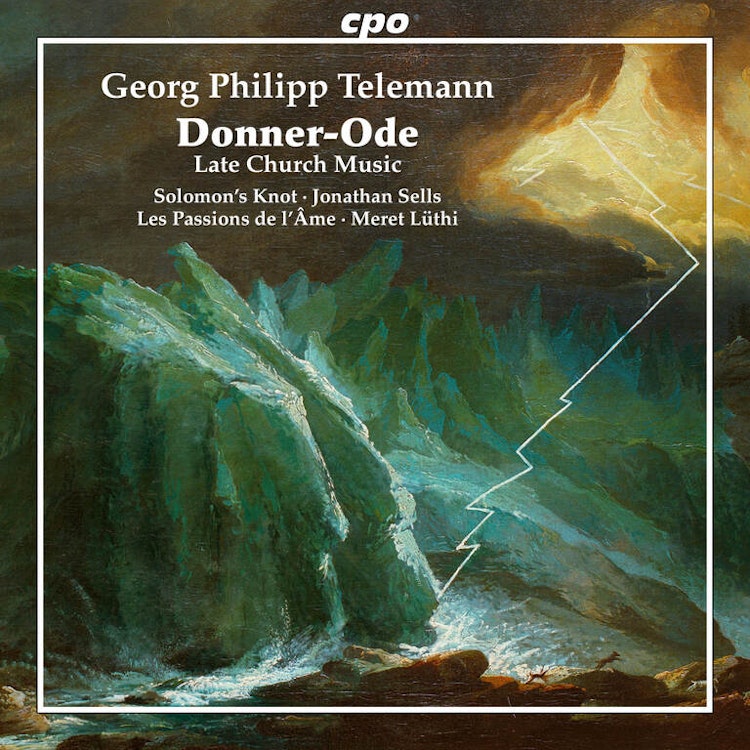
The text for Telemann's "Donner-Ode" was compiled by Karl Wilhelm Ramler and Christian Gottfried Krause "on the occasion" of the devastating 1755 Lisbon earthquake, which profoundly impacted European intellectual thought.
Compositional Technique
In "Wie lieblich sind auf den Bergen," Telemann uses three trumpets and timpani to imitate thunder when the text mentions the "thunder of strict laws," and two transverse flutes to evoke shepherds.
Composition History
Telemann's "Wie lieblich sind auf den Bergen" (How beautiful upon the mountains are the feet of him) was composed in 1754 for the installation of Joachim Lütken as pastor in Steinbek, near Hamburg, and was conducted by Telemann himself.
Composition History
Telemann's "Dich rühmen die Welten" (The worlds praise you) was first performed on St. Michael's Day in 1762 in Hamburg's Petrikirche, based on a poem by Johann Joachim Eschenburg, a student Telemann encouraged.
Performer Biography
Solomon's Knot is an international collective of instrumentalists and singers who perform early music without a conductor, often singing from memory and drawing inspiration from innovative live theater.
Composition History
Telemann's "Donner-Ode" (Ode of Thunder) was named for its realistic timpani thunder in the bass duet "Er donnert" (He thunders) and was one of his most famous works during his lifetime.
Composer's Artistic Vision
Georg Philipp Telemann's late compositional style was closely tied to the texts, featuring clear declamation, emotional interpretation, tone painting, short melodies, harmonic flexibility, and diverse forms.
You might also enjoy...
Easter Cantatas
Bach, J.L.: Missa Brevis / Cantatas
Telemann: Cantatas & Fantasies for Viola da gamba
Telemann: Der Messias, TWV 6:4 & Einweihungskantate für die Rellinger Kirche
Dietrich Fischer-Dieskau sings Baroque Arias (1952-1954)
Leipzig 1723 - Telemann | Graupner | Bach
Georg Philipp Telemann: A Christmas Oratorio
Christmas Cantatas, Vol. 2
Bach: Aus der Tieffen
J.M. Bach, G.C. Bach, J.C. Bach: Cantatas by members of the Bach family