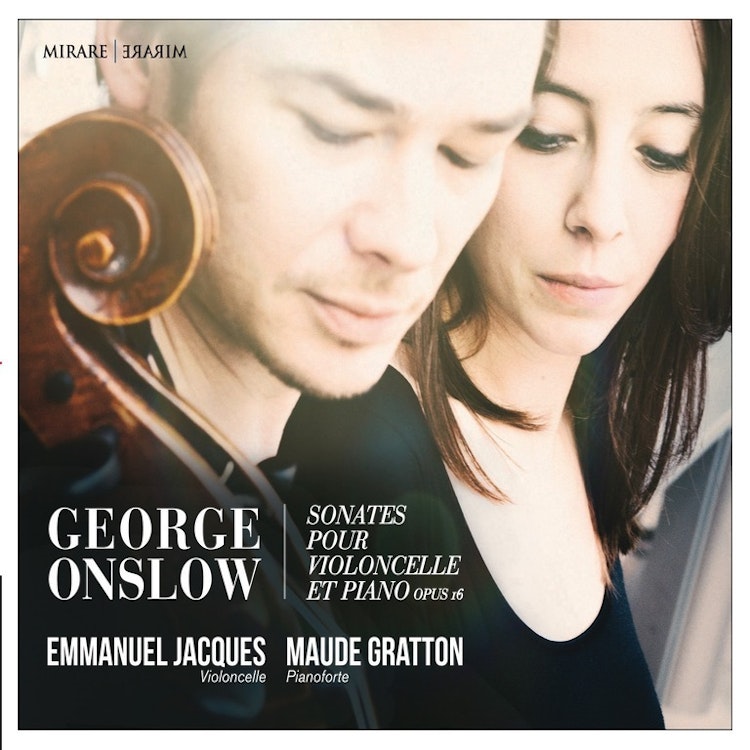
George Onslow: Sonates pour violoncelle et piano, Op. 16
5/5/2014, 10 Tracks, 1:02:46
Featuring
Emmanuel Jacques
Maude Gratton
George Onslow
Did you know?
1/7
Instruments
Emmanuel Jacques plays a cello made by Jacques Boquay in Paris in 1726 and a bow by Alexandre Aumont, a copy of one by F.X. Tourte.
Recording & Production
This recording was made at La Ferme de Villefavard in Limousin, a venue known for its exceptional acoustics designed by international acoustician Albert Yaying Xu.
Compositional Technique
Onslow's sonatas break from the French tradition where the piano was supreme, instead championing equal roles for instruments, similar to Beethoven.
Critical Reception
The German press, specifically the Allgemeine Musikalische Zeitung, described Onslow as having a 'richly inventive mind' and a 'varied and original idiom'.
Critical Reception
Hector Berlioz, a French Romantic composer, praised Onslow's ability to handle contrasting styles, admiring the 'calm beauty of several of his adagios and the effervescent vigour of most of his finales'.
Composition History
George Onslow's Three Sonatas for Cello and Piano, Op. 16, published in 1820, were the first sonatas of their kind in France.
Composer Biography
George Onslow, a cellist himself, dedicated his Sonatas Nos. 1 and 2 to Charles Baudiot and Louis Norblin, both professors at the Paris Conservatoire.
You might also enjoy...
Alkan: Sonate de concert in E Major, Op. 47
Poulenc: Cello Sonata, FP 143: II. Cavatine
Deux Morceaux: I. Nocturne (Arr. for Cello & Piano by Julian Riem)
Fauré: Après un rêve & Les berceaux
Master Series – Fauré: Piano Trio In D Minor, Op. 120
Onslow: Cello Sonatas
J.S. Bach, Gounod: Ave Maria
Poulenc: Les chemins de l'amour, FP. 106 (Transcr. for Cello and Piano)
Master Series – Fauré: Piano Trio in D Minor, Op. 120
Poulenc: Sonata for Cello and Piano, FP 143: II. Cavatine
Saint-Saëns: Le carnaval des animaux, R. 125: XIII. Le cygne (Arr. Godowsky for Cello & Piano)