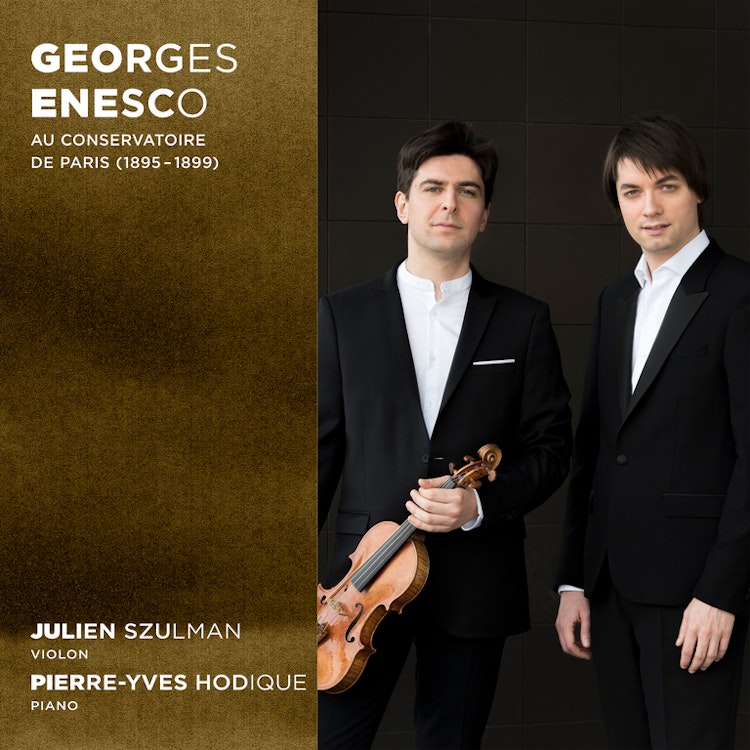
Georges Enesco au Conservatoire de Paris (1895-1899)
12/4/2020, 11 Tracks, 1:15:49
Featuring
Julien Szulman
Pierre-Yves Hodique
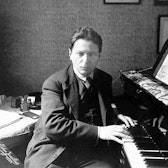
George Enescu
André Gedalge
Martin Pierre Marsick
Did you know?
1/7
Composer Biography
George Enescu began learning the violin as a self-taught musician in Romania and was so precocious that he entered the Vienna Conservatory at the age of seven, with an age exemption.
Interpretation
The pianist, Pierre-Yves Hodique, used a piano part for Enescu's Second Sonata that belonged to Céliny Chailley-Richez, which contains handwritten notes believed to be from Enescu himself.
Composer Biography
George Enescu, a composer, violinist, pianist, and conductor, is considered an integral figure in the history of music from the first half of the 20th century.
Composition History
The album features works composed by or for George Enescu during his studies at the Conservatoire de Paris between 1895 and 1899, including his first two Sonatas and pieces dedicated to him by André Gédalge and Martin-Pierre Marsick.
Composer's Artistic Vision
George Enescu felt his Second Sonata for piano and violin, Opus 6, marked a significant development in his compositional voice, stating, "I felt that I was rapidly developing, becoming a composer in my own right."
Interpretation
The handwritten notes in Céliny Chailley-Richez's score for Enescu's Second Sonata indicate that the piano part should sometimes evoke orchestral instruments like 'harp,' 'horn,' or 'bassoon,' and the finale's initial theme represents 'un gosse de Poulbot' (a street urchin).
Composition History
André Gédalge, a composer and future professor at the Conservatoire, dedicated his First Sonata for piano and violin to the sixteen-year-old George Enescu in 1897, confirming the strong impression Enescu made as a young virtuoso.
You might also enjoy...
French Resonance
Le streghe
Quasi una fantasia…
Poèmes
Maliszewski: Works for Violin and Piano
Enescu, G.: Violin Sonatas Nos. 2 and 3
Works for Violin and Piano By Igor Stravinsky and Dmitri Shostakovich