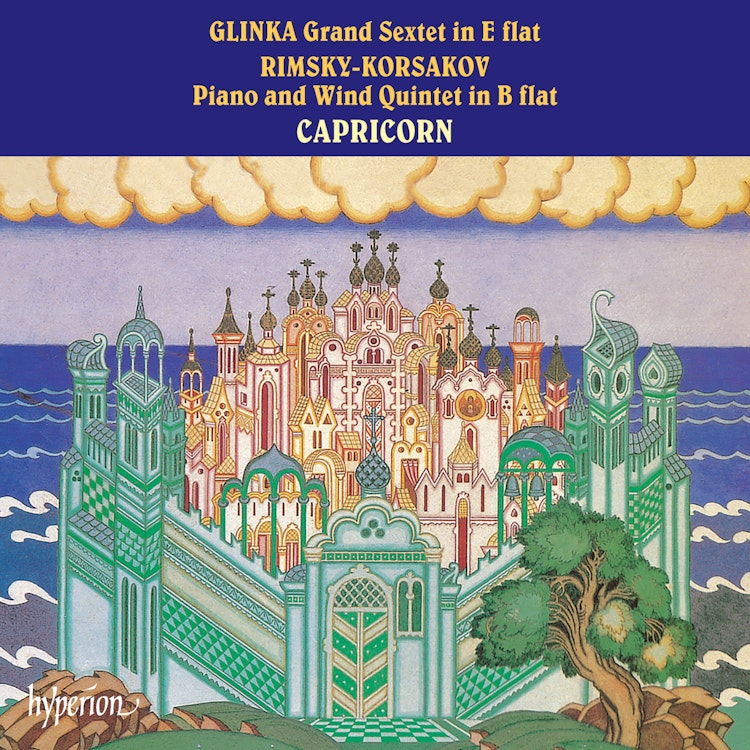
The 44 years separating the two works on this recording saw a significant development in Russian musical life, with nationalist composers becoming established and music reaching a wider bourgeois audience.
Historical Context
The Russian Imperial Music Society was formed in 1859, founding a Conservatory in 1860 where Tchaikovsky was one of the first pupils.
Historical Context
Russian cultural life was increasingly influenced by Western European ideas from the reign of Peter the Great (1682-1725) onwards, with Italian and French operas performed in St Petersburg.
Critical Reception
Rimsky-Korsakov's Quintet was disregarded by a competition jury due to a 'mediocre sight-reader' but pleased the audience greatly at a later public concert.
Composer Biography
Mikhail Ivanovich Glinka, the composer of the Grand Sextet, was a skilled singer and pianist who took lessons from John Field and impressed Hummel.
Composition History
Glinka composed his Grand Sextet while living near Lake Maggiore for his health, initially for his doctor's married daughter, but dedicated it to her friend due to gossip.
Historical Context
The Free School of Music, formed in 1862, emphasized a Russian style and gave regular concerts of Russian works conducted by Balakirev and Rimsky-Korsakov.
You might also enjoy...
French Music for Flute, Harp And String Trio
Right Through The Bone - Chamber Music of Julius Röntgen
From the Beginning: Music for Winds and piano by Mozart, Thuille and Poulenc
Baroque Music - Handel, G.F. / Corrette, M. / Lalande, M.-R. De / Cruger, J. (Festive Trumpet Concerto, Vol. 4)
Douze guitares à Paris
Beethoven: Quintet for Piano & Winds / Spohr: Wind Septet
Thuille: Sextet, Piano Quintet
Poulenc: Chamber Music
POULENC, F.: Sextet / Trio for Oboe, Bassoon and Piano / FRANCAIX, J.: Octet / Dixtuor (Linos Ensemble)
Rimsky-Korsakov / Beethoven: Piano Quintets / Berwald: Piano Quartet