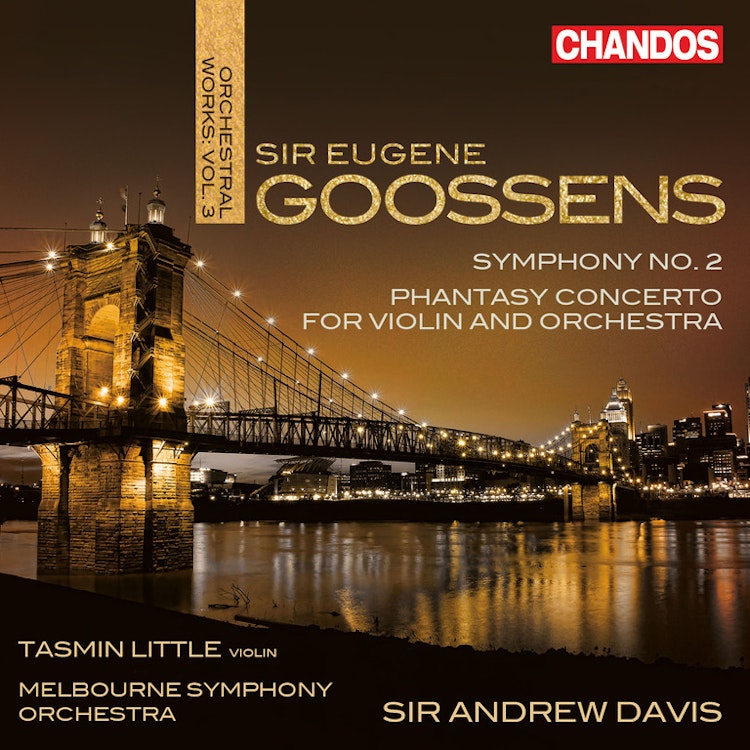
Composer and conductor Sir Eugene Goossens was a major musical figure in the early 20th century, first in his native England and later in the USA and Australia. Sir Andrew Davis and the Melbourne Symphony Orchestra's third volume of Goossens's orchestral works contains two late compositions: the Symphony No. 2 (1942-5), his response to the War, and the Phantasy Concerto for violin and orchestra, premiered in 1959 and here performed by Tasmin Little.
Featuring
Tasmin Little
Sir Andrew Davis
Melbourne Symphony Orchestra
Sir Eugene Goossens
Did you know?
1/7
Critical Reception
After World War II, Goossens's music, once seen as modern, began to be considered 'old hat' by critics, making objective assessment difficult.
Compositional Technique
The 'Phantasy' in the concerto's title refers to a compositional style encouraged by W.W. Cobbett, where one-movement chamber works adopt an arch structure encompassing constituent movements within a single span.
Composition History
The Phantasy Concerto for Violin and Orchestra was originally written for the famous violinist Jascha Heifetz, but he never performed it because he disliked the score.
Composer's Artistic Vision
Eugene Goossens stated that his First Symphony had no 'message' or literary significance, dealing instead with 'The Eternal Verities' as his teacher Sir Charles Villiers Stanford called them.
Composition History
Both the Symphony No. 2 and the Phantasy Concerto were composed in the shadow of the Second World War.
Composer Biography
Eugene Goossens (the composer) came from a large, high-achieving musical family, including his father and grandfather who were also conductors, and his siblings who were famous harpists and an oboist.
Composer Biography
Sir Thomas Beecham, a famous conductor, recognized Eugene Goossens's talent early on and gave him conducting engagements, sometimes at very short notice and without rehearsal.
You might also enjoy...
Walton: Violin Concerto & Symphony No. 1
Vaughan Williams: Lark Ascending, A Sea Symphony (Symphony No1)
Walton: Violin Concerto - Symphony No. 1
Walton: Symphony No. 1 - Violin Concerto
Bliss: Colour Symphony (A) / Violin Concerto
Alwyn: Symphony No. 3 / Violin Concerto
Vaughan Williams: Symphony No. 5 / The Lark Ascending
Vaughan Williams: Symphony No. 4 / Violin Concerto in D Minor
20th Century Classics: Walton
Vaughan Williams: The Complete Symphonies, The Lark Ascending, Tallis Fantasia, etc.