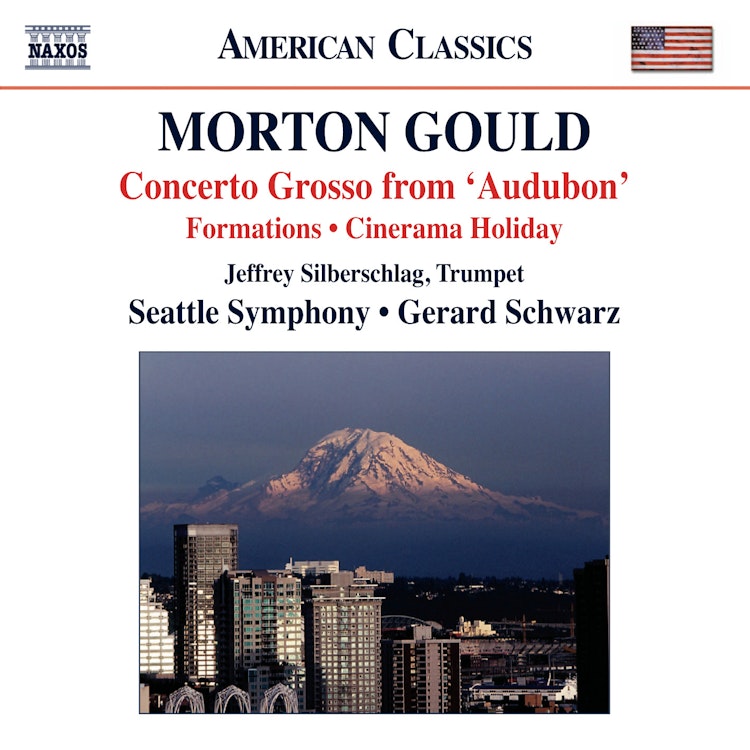
Gould: Concerto Grosso - Cinerama Holiday Suite - World War I - Formations
11/1/2012, 21 Tracks, 1:00:36
Featuring
Gerard Schwarz
John Weller
Mikhail Shmidt
Maria Larionoff
Mariel Bailey
Jeffrey Silberschlag
Seattle Symphony
Morton Gould
Did you know?
1/7
Compositional Technique
The Concerto Grosso from 'Audubon' is scored for four violins and orchestra, and Morton Gould described it as a 'transformation of hoedown tunes' with rhythmic asymmetries and surprising harmonic shifts.
Composer Biography
Morton Gould's career spanned and often blurred the traditional boundaries between 'serious' and 'popular' music, encompassing symphonic works, ballets, Broadway shows, film scores, and television soundtracks.
Historical Context
Morton Gould composed the score for the 1955 film Cinerama Holiday, which was commissioned to demonstrate the potential of Cinerama, a new movie projection technology using a large curved screen and three synchronized projectors.
Composer Biography
Morton Gould, like George Gershwin and Aaron Copland, was raised in New York by Jewish immigrant parents and showed exceptional musical ability from a young age.
Performer Biography
Jeffrey Silberschlag, the trumpet soloist on this album, has had pieces written for him by several composers, including Morton Gould, the composer featured on this recording.
Composition History
Morton Gould's Concerto Grosso from 'Audubon' was originally intended for a ballet choreographed by George Balanchine, but the collaboration was ill-fated and the ballet remained unfinished.
Composer's Artistic Vision
Morton Gould, the composer, retained traditional notions of melody and harmony, seeing no artistic compromise in writing accessible music for a broad audience, even during the rise of high-modernism.
You might also enjoy...
Schumann: Symphony No.10 & New England Triptych & American Festival Overture
Fine, I.: Music for Orchestra / Diversions / Symphony / Blue Towers / Toccata Concertante
Victory Stride: The Symphonic Music Of James P. Johnson
Ives: Three Places in New England; Symphony No.3; The Unanswered Question; A Set of Pieces
Copland: Rodeo/El Salón Mexico/Billy the Kid/Danzón Cubano
Gershwin: An American in Paris - Porgy and Bess Suite
Ives: Symphony No.4; Central Park in the Dark; Three Places in New England
Copland: Symphony No. 3 - Danzon Cubano - El Salon Mexico
Korngold: Works for Orchestra
Coolidge: Rhapsody for Harp & Orchestra & Orchestral Works
Barber: Piano Concerto / Die Natali / Medea's Meditation