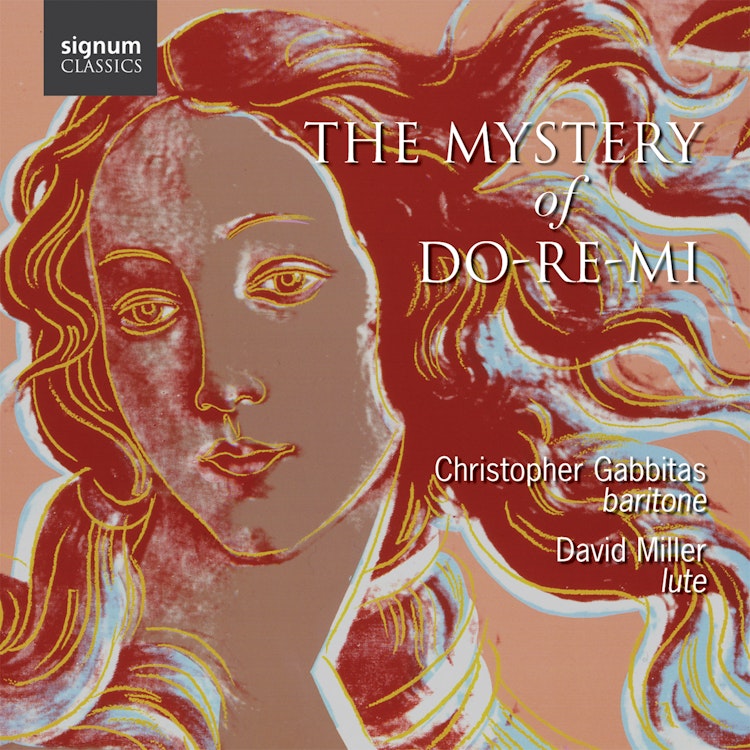
David Miller, the lutenist, is a professor of lute at the Guildhall School of Music and Drama and at Trinity College of Music.
Performer Biography
Christopher Gabbitas, the baritone on this album, was a practicing solicitor at a top city law firm from 2001 to 2003 before joining The King's Singers.
Instruments
The lute on this recording is plucked with a plectrum in the performance of Horace's Ode to Phyllis, in keeping with classical period practice.
Album & Artwork
This album is published in conjunction with 'Horace's Odes and the Mystery of Do-Re-Mi' by Stuart Lyons, which establishes a link between Horatian music, Guido d'Arezzo, and the invention of do-re-mi.
Interpretation
The performance of Horace's Ode to Phyllis attempts to replicate the ambience of the sunken dining hall of Horace's sponsor and friend Maecenas, built around 30 BC.
Composition History
The do-re-mi solmization system, invented by Guido d'Arezzo, originally used the names ut-re-mi, taken from an 8th-century hymn by Paul the Deacon.
Composition History
The music for the do-re-mi system, which Guido d'Arezzo used, was not composed by him but was an arrangement of Horace's Ode to Phyllis, found in a 10th-century Carolingian manuscript.
You might also enjoy...
Debussy: 3 Chansons de Bilitis, L. 96 - Hindemith: Hérodiade
Larsson: Forkladd Gud (God in Disguise) / Rosenberg: Den Heliga Natten (The Holy Night)