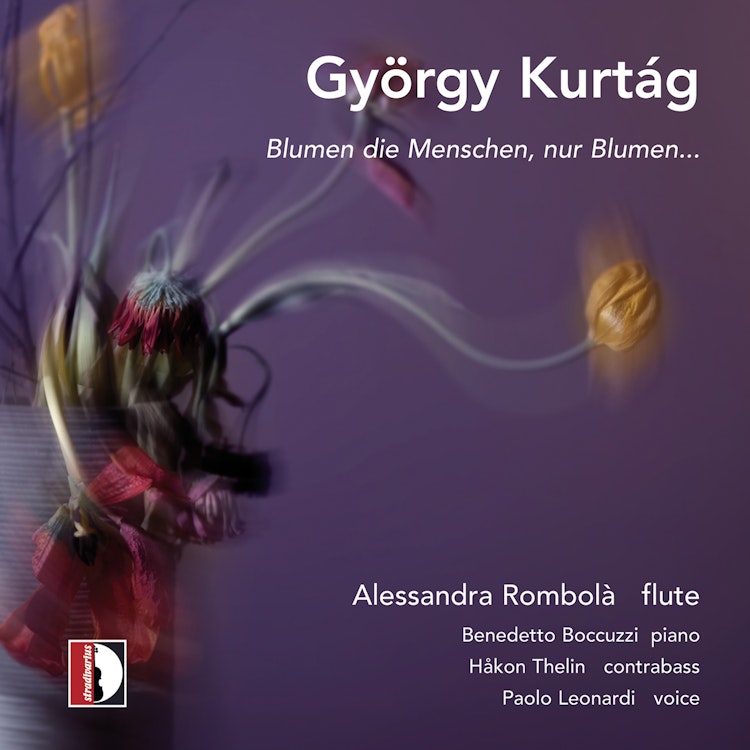
Many of Kurtág's pieces are homages to other composers, friends, and artists, and are often conceived as 'messages'—a recurring term in his titles.
Interpretation
Kurtág's music demands a deep, gestural, and bodily understanding from the performer due to its complex playing techniques, innovative notation, and flexible rhythm.
Performer Biography
Alessandra Rombolà, the flutist on this album, is a versatile musician specializing in contemporary music and improvisation, performing both notated and graphic scores.
Composer Biography
György Kurtág, born in 1926 in Romania, studied at the Music Academy in Budapest where he became lifelong friends with György Ligeti, another influential composer.
Composer Biography
Kurtág dedicated his String Quartet Op. 1 and Kafka Fragments Op. 24 to Hungarian psychologist Marianne Stein, who helped him overcome a creative crisis.
Compositional Technique
Kurtág's musical style is characterized by essentiality, concise and fragmentary signs, continuous reworking, and a focus on the expressive value of intervals.
Composer's Artistic Vision
Kurtág's works often feature recurring themes, motives, and references, demonstrating an 'intertextual praxis' that characterizes his entire output.
You might also enjoy...
Michael Quell: Chamber Music, Vol. 3
Music for Flute And Guitar
Scelsi Collection, Vol. 6
Norwegian Flute (The)
Piccolo: Imaginary Symphony and other tales
David Patterson: Loon's Tail Flashing
Andrew Thomas & Benjamin Wittiber & Eckhard Kopetzki & Emmanuel Séjourné & John Thrower & Keiko Abe & Matthias Schmitt & Ney Rosauro: Marimba Dance
Sea of Stars
Collaborations
Cage, J.: Sonata for 2 Voices / One4 / Wolff, C.: Pulse / Trio I / Walter, C.J.: Reigen (Trumpet and Percussion)
Berio: The Complete Sequenzas, Alternate Sequenzas & Works for Solo Instruments