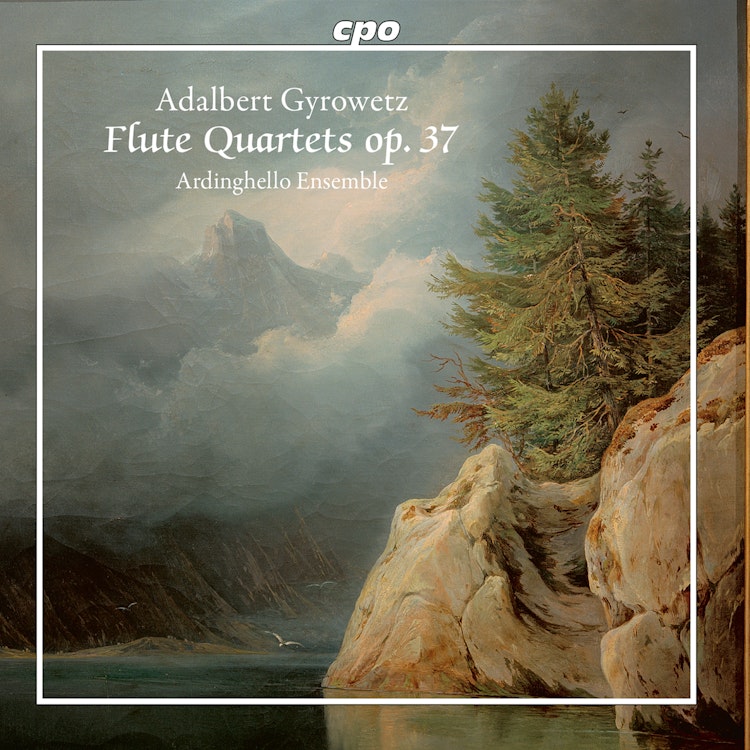
All three quartets are in three movements (fast-slow-fast), which was an exception around 1800, as Haydn's mature string quartets had established the four-movement form.
Composition History
The quartets for flute and string trio, Op. 11, were published in 1791 by the well-known Offenbach publisher André, placing Gyrowetz among his famous contemporaries.
Composer's Artistic Vision
Gyrowetz's music is heavily influenced by Haydn's classical style, emphasizing architectural structures, harmonic tension, and music as a balanced language of feeling and reason.
Interpretation
The Ardinghello Ensemble is inspired by historical performance practice, using historical bows and flutes from the Classical and Romantic periods to achieve an authentic sound.
Composer Biography
Adalbert Gyrowetz, a highly talented Czech musician, met Haydn, Mozart, and Dittersdorf in Vienna and later served as Kapellmeister of the Court Theater there.
Composer Biography
During Joseph Haydn's first stay in London, Gyrowetz served as his admiring companion and polyglot interpreter, speaking six languages.
Compositional Technique
The key choices of C major, G major, and D major for these quartets are typical for high classical cycles and are well-suited for the classical transverse flute with four keys and string instruments.
You might also enjoy...
Geliebte Dorette: Musica per violino e arpa di Louis Spohr
Suite for Chamber Orchestra and Jazz Piano Trio
Shostakovich: Seven Romances on Poems by Alexander Blok, Op. 127 (Live)
Bartók: Contrasts for Clarinet, Violin & Piano, Sz. 111
Schönberg: Serenade, Op. 24
Carmen
Krommer, F.: Partitas - Opp. 71, 73, 77, 78
Spohr: Sonatas for Harp & Violin
Schoenberg: Serenade, Op. 24
Weinberg: Rhapsody on Moldavian Themes, Op. 47 (Arr. for Ensemble by Michael Csányi-Wills) [Excerpt]