Halvorsen's 'Sorte Svaner' (Black Swans) was presented under the pseudonym 'Tschernowsky' in 1921, likely because 'modernism' was a 'dirty word' among conservative Norwegian critics at the time.
Composition History
Halvorsen often reused earlier compositions for stage music due to time constraints, such as 'Danse visionaire,' which was inspired by a poem from Arne Garborg's epic cycle Haugtussa.
Composer's Artistic Vision
Halvorsen's incidental music to Fossegrimen is considered a series of dialogues between different styles and traditions, synthesizing contrasting musical sounds.
Composer Biography
Johan Halvorsen, the composer, began his musical journey at an early age, learning violin, flute, cornet, and other brass instruments in his hometown of Drammen, Norway.
Composer Biography
Halvorsen was appointed leader of the Orchestra Harmonien in Bergen, the former name of the Bergen Philharmonic Orchestra, and later became Director of Music at the National Theatre in Kristiania (now Oslo), conducting around 300 concerts up to 1919.
Composition History
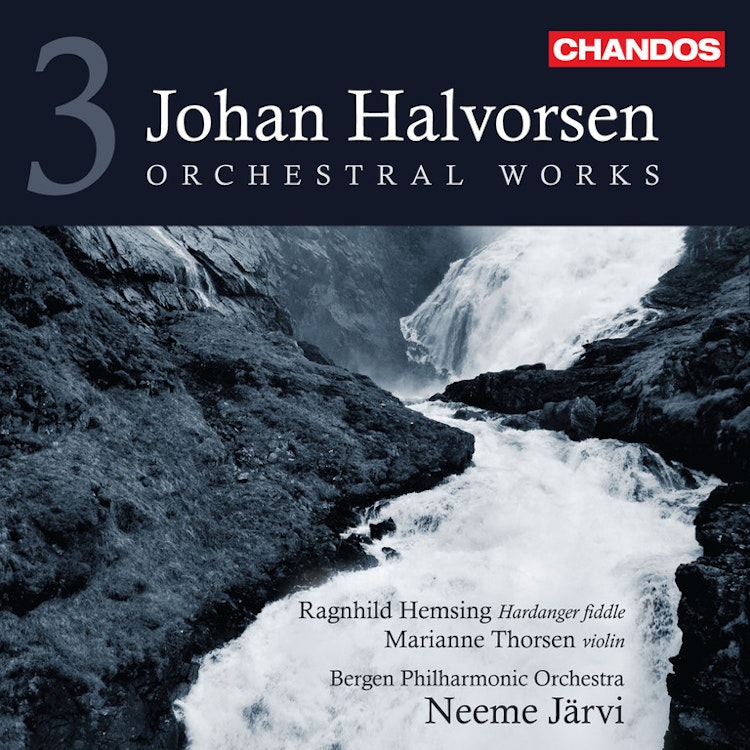
For his incidental music to Fossegrimen, a 'troll-play' by Sigurd Eldegard, Halvorsen was not only the composer and conductor but also the soloist on the Hardanger fiddle, a Norwegian 'national instrument,' used for the first time with a symphony orchestra.
Compositional Technique
Halvorsen's Third Symphony, composed in 1928, is unique among his symphonies for having a slow introduction to its first movement and for merging the traditional second and third movements into a single Andante with a scherzo-like middle section.
You might also enjoy...
Granados: Orchestral Works
Leif Segerstam 80 Years
Modern Times Edition
Nocturne
Classics for All Seasons: Summer
Alfven: Swedish Rhapsodies Nos. 1-3 / En Skargardssagen / Gustav Ii Adolf (Excerpt)