The Sinfonia for this recording uses Hasse's Concerto No. 2 in D Major to fill a gap in Handel's conducting score, as only a basso continuo line of unknown origin survived for the original.
Composition History
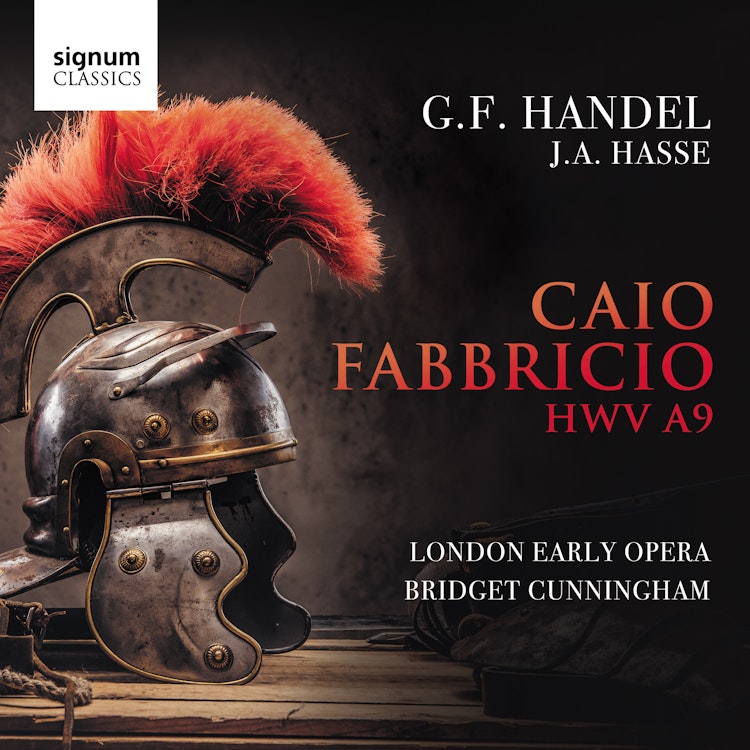
Caio Fabbricio is a "pasticcio opera," a compilation of 18th-century Neapolitan arias by various composers, selected and arranged by George Frideric Handel.
Recording & Production
London Early Opera, a UK charity, funded the digitization of Handel's conducting score for Caio Fabbricio and created this world premiere recording, which features Handel's expert selection of Neapolitan music.
Composer Biography
George Frideric Handel, as Master of the Orchestra for the Royal Academy of Music, played a significant role in establishing opera in London and introducing the music of Johann Adolf Hasse to the public.
Historical Context
Handel premiered Caio Fabbricio in 1733 amidst a tumultuous year for the Royal Academy, marked by political factionalism, high ticket prices, and the formation of a rival opera company, the Opera of the Nobility.
Compositional Technique
Handel's pasticcio operas, like Caio Fabbricio, combined his own contrapuntal working methods with the modern, melody-led Neapolitan lyrical style of composers such as Johann Adolf Hasse, Leonardo Vinci, and Leonardo Leo.
Composition History
The libretto for Caio Fabbricio, by Apostolo Zeno, is based on the historical story of the Roman ambassador Caio Fabbricio and the warlike King Pyrrhus, whose "Pyrrhic victory" is the origin of the figurative expression.
You might also enjoy...
Treasures: Chamber Music from the Collection of Earl Rudolf Franz Erwein von Schonborn zu Wiesentheid
Perle del Piemonte: Violin Music in 18th-Century Italy
Handel Edition Volume 3 - L'Allegro, Il Penseroso ed il Moderato, Tamerlano, Alcina, Il Pastor Fido, Terpsichore
Graupner: Orchestral Suites
Bach, C.P.E. / Benda / Frederick Ii / Graun: Sonatas / Quantz: Flute Concerto in A Major