Haydn: Die sieben letzten Worte unseres Erlösers am Kreuze (Vokalfassung)
3/4/2022, 10 Tracks, 50:03
Featuring
Anna-Lena Elbert
Hannah Gries
Sophie Harmsen
Florian Sievers
Sebastian Noack
Frieder Bernius
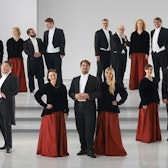
Kammerchor Stuttgart
Hofkapelle Stuttgart
Joseph Haydn
Did you know?
1/7
Compositional Technique
Haydn's original commission for "The Seven Last Words" required seven Adagios, each lasting about ten minutes, a challenging task to avoid listener fatigue.
Compositional Technique
The vocal version of Haydn's work includes short a cappella movements in the archaic falsobordone style, which precede most pieces and feature German translations of Jesus's words.
Composition History
Haydn created his own vocal version of "The Seven Last Words" after encountering an arrangement by Kapellmeister Joseph Friebert in Passau, which he felt he could improve upon.
Composition History
Haydn's "The Seven Last Words of our Savior on the Cross" was originally commissioned by a canon in Cadiz, Spain, around 1785, as instrumental music for a special Good Friday service.
Performer Biography
Frieder Bernius, the conductor, founded the Kammerchor Stuttgart in 1968, the Barockorchester Stuttgart in 1991, and the Hofkapelle Stuttgart in 2006, showcasing his stylistic versatility.
Historical Context
The Good Friday service in Cadiz, for which Haydn's work was composed, involved the church being draped in black cloth, illuminated by a single lamp, and featured a bishop meditating on each of Jesus's last words, interspersed with music.
Critical Reception
The vocal version of Haydn's "The Seven Last Words" became more popular than the original orchestral version during the 19th century, an era of flourishing choral societies.
You might also enjoy...
Mozart: The Masses, Vol.4
Mozart: Requiem
Haydn: Great Choral Works
Haydn: Jahreszeiten (Die) (The Seasons)
Martin: Golgotha
Spohr: Die letzten Dinge
Franck : Les Béatitudes
Schmidt: Das Buch mit sieben Siegeln (The Book with Seven Seals)
Schubert: Lazarus, oder Die Feier der Auferstehung, D. 689