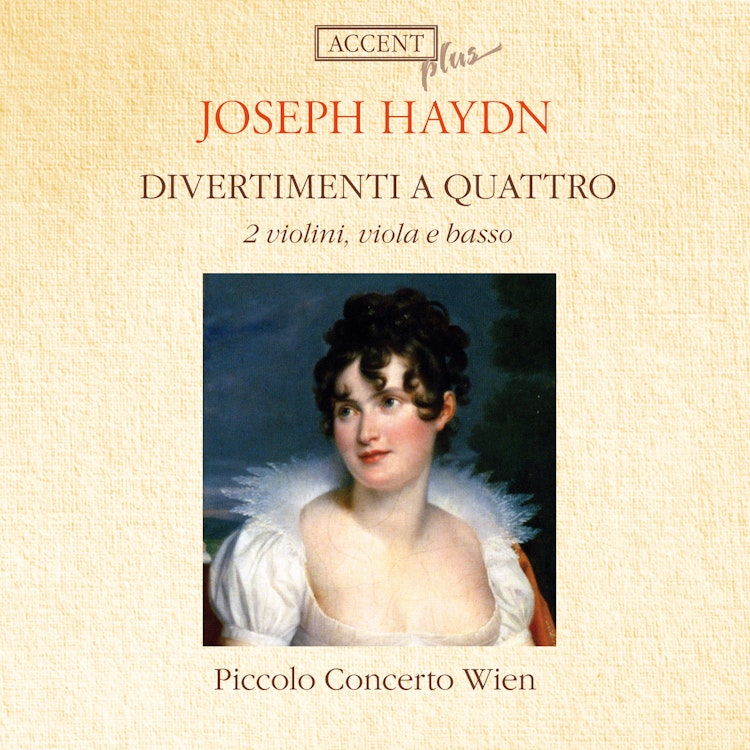
These early Haydn works feature surprise modulations and irregular musical periods of 3, 5, or 7 bars, especially in the conclusive movements.
Composer's Artistic Vision
In these Divertimenti, Haydn experimented with systematically analyzing the potential of a given instrument combination or genre, which became characteristic of his artistic evolution.
Performer Biography
Piccolo Concerto Wien, founded in 1993, specializes in chamber music off the beaten track, historical instruments, and experimentation, often performing works by lesser-known masters.
Historical Context
These Divertimenti were mistakenly published as Haydn's String Quartets Op. 1 and Op. 2 by publishers Chevardiere and Hummel, and later by Ignaz Pleyel, a former student of Haydn.
Composition History
Haydn's Divertimenti a quattro were originally commissioned as entertainment music by nobleman Karl Joseph Edler von Nürnberg for his summer residence.
Instruments
The 'Violone' used in these compositions is different from a modern double bass, having frets like a viol, five or four strings, and a unique tuning for agility.
Compositional Technique
Haydn's Divertimenti a 4 are among the first compositions to explore string music without the support of a basso continuo, typically realized by a keyboard instrument.
You might also enjoy...
Haydn: Complete String Quartets
Haydn: The Complete String Quartets
Haydn: The Complete String Quartets
Haydn: String Quartets, Op. 20 Nos. 1-3
Haydn: String Quartets Op. 33 Nos 1-3
Haydn: String Quartets, Op. 33 Nos. 1-3 (On Period Instruments)