In April 1763, two new horn players, Franz Reiner and Karl Franz, joined Prince Nikolaus Esterházy's court, doubling the horn contingent to four, which was rare for the time.
Interpretation
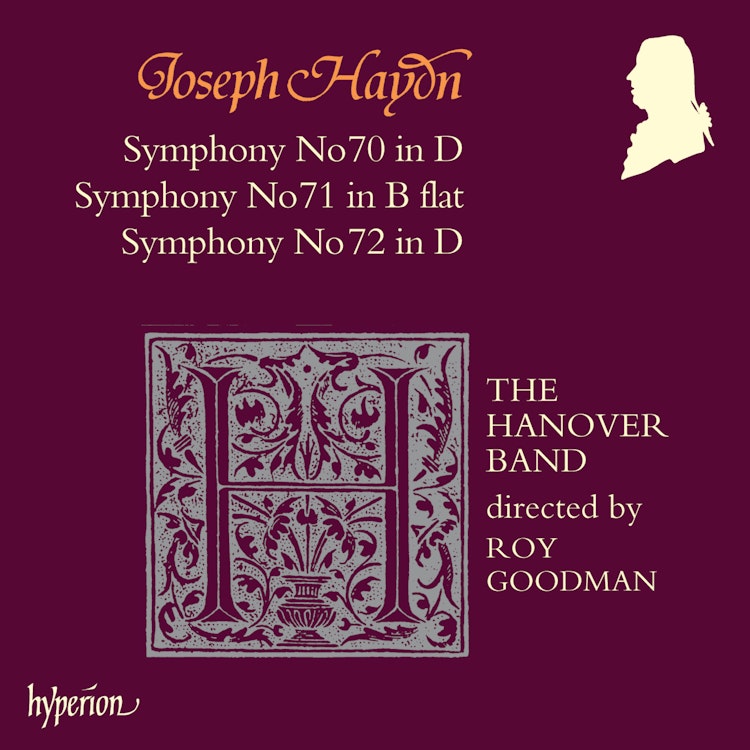
Roy Goodman, the director, reassesses the tempo of Andante and Minuet movements, which he believes are often performed too slowly nowadays, based on markings by Hummel and Czerny.
Compositional Technique
Symphony No. 72 features demanding writing for the horns, with the first horn part often reaching 'stratospherical' tessitura.
Compositional Technique
Symphony No. 70 showcases Haydn's contrapuntal skills, featuring a two-part canon in the Andante and a triple fugue in the Finale.
Composition History
Haydn composed Symphony No. 70 in D major for the ceremony of laying the foundation stone for a new, grander opera theatre at Eszterháza after a fire destroyed the previous one.
Composition History
Haydn's Symphony No. 72 was written as a display piece for his new horn quartet, which included the virtuosic Karl Franz.
Interpretation
The Hanover Band performs on period instruments at a pitch of A = 430Hz, and the director, Roy Goodman, conducts from the harpsichord for symphonies 1 to 92.