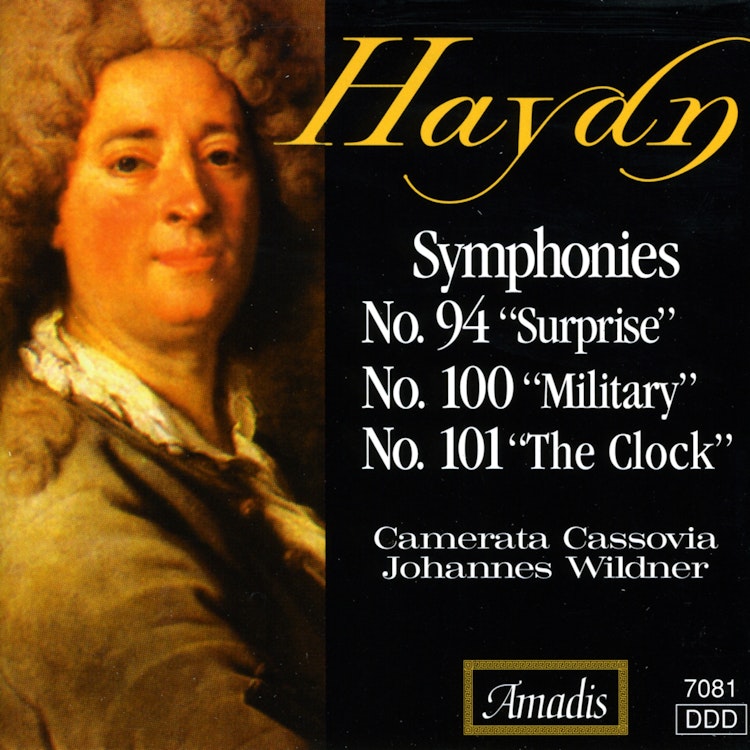
Haydn: Symphonies Nos. 94, "The Surprise", 100, "Military" and 101, "The Clock"
10/6/1995, 12 Tracks, 1:17:18
Featuring
Johannes Wildner
Camerata Cassovia
Joseph Haydn
Did you know?
1/6
Composition History
Haydn's considerable success during his first visit to London in 1791, where he provided music for concerts organized by Johann Peter Salomon, led to a second visit in 1794.
Composer Biography
Haydn spent many years as Kapellmeister (director of music) for the Esterházy family, a position that involved writing music of all kinds and directing performances.
Composer Biography
Joseph Haydn, the composer of these symphonies, was born in 1732 and began his musical career at age eight, joining the choir of St. Stephen's Cathedral in Vienna.
Compositional Technique
Symphony No. 101, 'The Clock', gets its nickname from the accompanying figure that opens its bright D major movement, which resembles a clock's ticking.
Critical Reception
The use of military percussion in the finale of Symphony No. 100, the 'Military' symphony, was disapproved of by one contemporary critic, despite providing unity to the work.
Compositional Technique
Symphony No. 100, known as the 'Military' symphony, includes a 'military battery' of kettledrums, triangle, cymbals, and bass drum in its second movement.