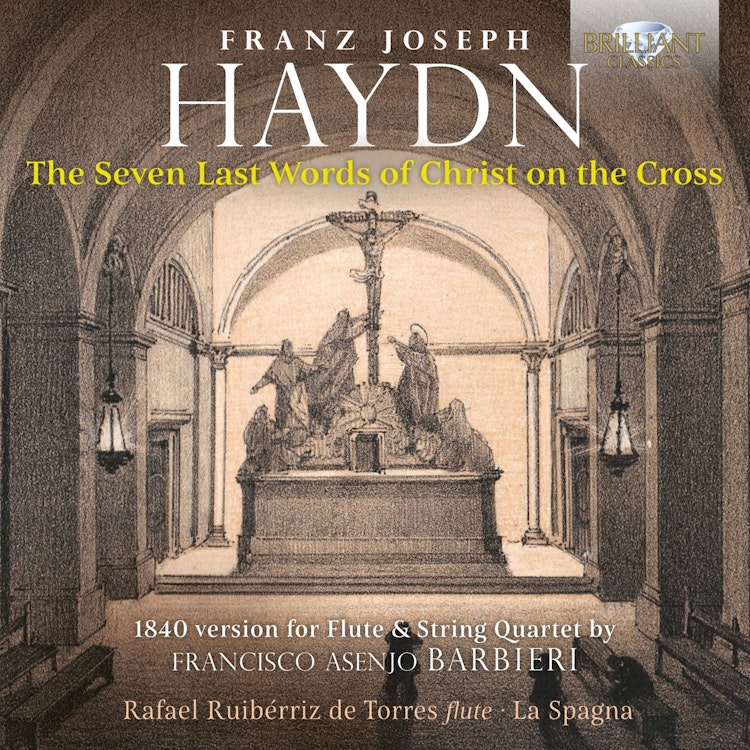
Haydn: The Seven Last Words of Christ on the Cross, 1840 Version for Flute & String Quartet by Francisco Asenjo Barbieri
10/26/2022, 9 Tracks, 1:16:20
Featuring
Rafael Ruibérriz de Torres
Irene Benito
Marta Mayoral
Rosa San Martín
Alejandro Marías
La Spagna
Joseph Haydn
Did you know?
1/7
Compositional Technique
Francisco Asenjo Barbieri's 1840 version for flute and string quartet is unique because the flute part is a completely new fifth voice with original melodic material, not a doubling or replacement of existing lines.
Composer Biography
Francisco Asenjo Barbieri, who arranged this version of Haydn's work, was a protean figure in Spanish classical music, known as a composer, conductor, writer, musicologist, and more.
Cultural Impact
The Seven Last Words achieved enormous popularity, leading to a large number of arrangements and its rapid dissemination across Europe and Spanish overseas territories.
Recording & Production
This specific Barbieri version of The Seven Last Words was revived in modern times by Rafael Ruibérriz de Torres and La Spagna at the Oratorio de la Santa Cueva in Cádiz on December 2, 2018.
Composition History
Haydn's The Seven Last Words of Christ on the Cross was commissioned for the 'Devotion of the Three Hours' service held annually on Good Friday in the Cathedral of Cádiz.
Compositional Technique
The Seven Last Words is uniquely structured with eight slow movements (an introduction and seven sonatas) and a fast final number, Il Terremoto, reflecting its specific religious function.
Composition History
The commission for Haydn's work likely came from José Sáenz de Santamaría and Francisco María de Paula Micón, two prominent members of the Confraternity, rather than the Cathedral of Cádiz itself.