Hertel's next influential teacher was the great violinist Franz Benda in Berlin, who praised Hertel's violin skills and predicted his success with vocal compositions.
Composer Biography
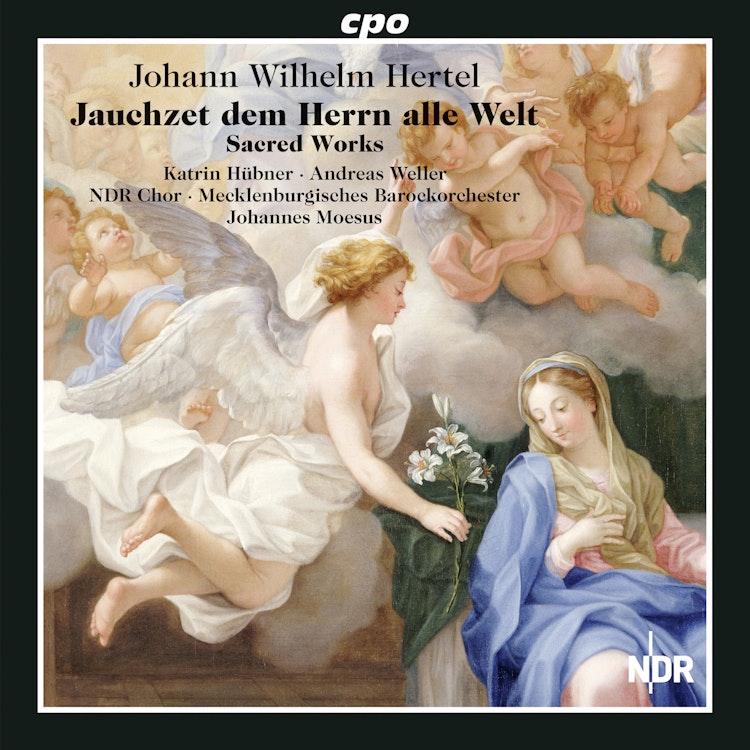
Johann Wilhelm Hertel, born in Eisenach, received harpsichord lessons from Johann Heinrich Heil, a former pupil of Johann Sebastian Bach.
Interpretation
The Mecklenburg Baroque Orchestra 'Herzogliche HofKapelle' performs on historical instruments or copies, aiming to recreate the sound of the Ducal Mecklenburg-Schwerin Court Orchestra from the 18th century.
Composer's Artistic Vision
Franz Benda, Hertel's teacher, believed in the inseparable link between voice and instrument, a key characteristic of music from the Age of Sensibility, where instruments were meant to be played like singing.
Composer Biography
In his later years, despite personal tragedies and failing health, Hertel composed four passion oratorios and a scientific work on carnations, including a mail-order catalog of over 200 varieties.
Composer Biography
Hertel was known as "the great Mecklenburger" by Carl Philipp Emanuel Bach, and he learned about orchestral culture while performing with King Frederick II's court ensemble in Berlin.
Composition History
Duke Friedrich, the ruling prince of Mecklenburg, had a vision for church music, introducing a three-part concerto form (chorale cantata - biblical text or psalm cantata - chorale cantata) to instruct his subjects in pietistic faith.
You might also enjoy...
Renaissance Portugal
Cadence: New Works for Voices in Verse
Le siècle d'or à la cathédrale de Mexico
Msze Staropolskie
Kastalsky: Memory Eternal
The Chants of Mary
Lent and Holy Easter
Ortiz: Choral Works
Rilke Ensemblen
Magi: Tree of Song
Berezovsky: Liturgy, Eucharistic Verses, Let the Lord Enthrone