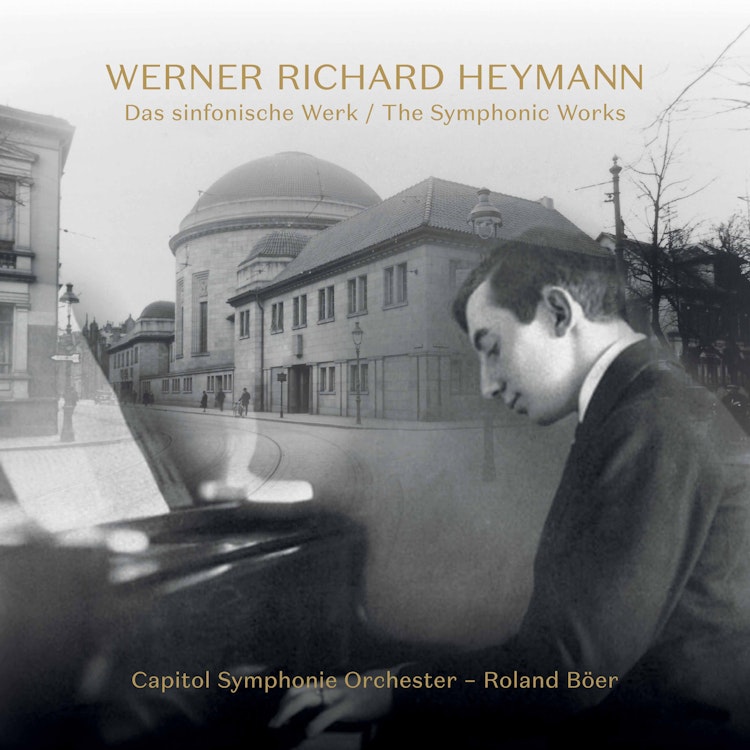
Heymann: Works for Orchestra - Rolf Rudin: Fausts Geheimnis, Op. 96
11/15/2019, 11 Tracks, 55:52
Featuring
Michael Porter
Roland Böer
Hans Christoph Begemann
Heike Wahl
Piotr Niewiadomski
Olaf Joksch
Capitol Symphony Orchestra
Werner Richard Heymann
Rolf Rudin
Did you know?
1/7
Cultural Impact
Werner Richard Heymann's later works as General Music Director for UFA, including a celebrated symphonic score for Murnau's 'Faust', are mostly lost, with only two fragments surviving.
Critical Reception
At the premiere of his 'Rhapsodische Sinfonie', Werner Richard Heymann, despite some critical remarks, was praised for his 'ideal seriousness, unaffected warmth and rapturous lyrical feeling' by Viennese critics.
Composer Biography
Werner Richard Heymann, the composer, spent years in the 'Café des Westens' in Berlin, a hub for artists like Erich Mühsam, Else Lasker-Schüler, Richard Strauss, and Friedrich Wilhelm Murnau.
Composer's Artistic Vision
During the First World War, Werner Richard Heymann chose to pursue the path of a serious orchestral composer for the concert stage, a decision he described as being made 'with utmost passion'.
Composition History
Werner Richard Heymann, at age 19, orchestrated his 'Frühlings-Notturno' by teaching himself from an instrument chart after his teacher Paul Juon told him it would take years to master orchestration.
Composition History
The 'Rhapsodische Sinfonie' by Werner Richard Heymann was composed under romantic circumstances, with Heymann orchestrating parts of it from a beach chair in Hiddensee and in Wernigerode.
Composer Biography
Werner Richard Heymann, known for his popular songs, considered himself a 'better songwriter than a symphonist', explaining why he no longer felt the need to write for the concert hall.
You might also enjoy...
Sculthorpe: Earth Cry / Piano Concerto / Kakadu
Worland: Tres Senoritas / Shopping Spree
Worland: Tres Senoritas / Shopping Spree
Romantic Ireland
Romantic Ireland
Schoenberg: A Survivor from Warsaw, Op. 46, Variations for Orchestra, Op. 31 & 5 Pieces for Orchestra, Op. 16