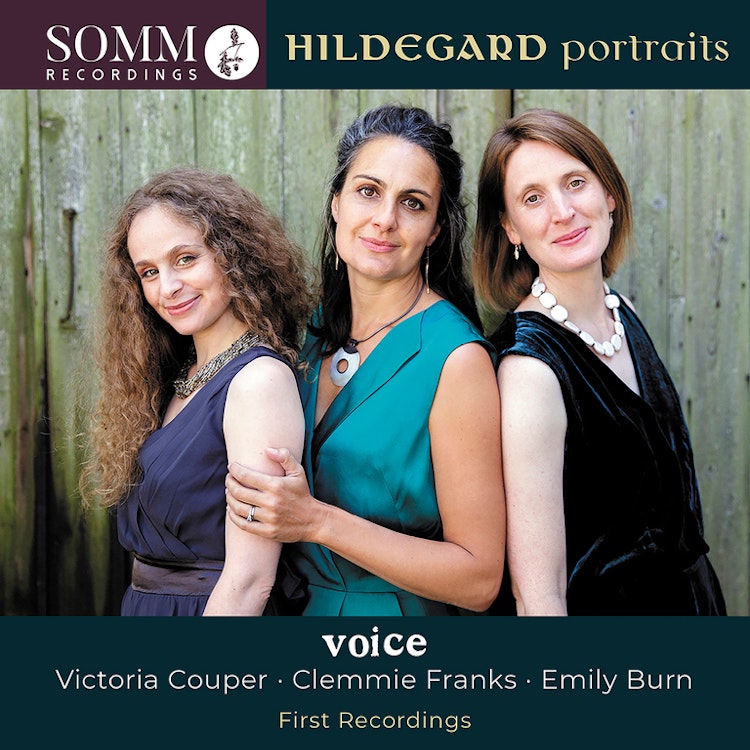
The trio Voice (Emily Burn, Victoria Couper, and Clemmie Franks) began singing together in their early teens as part of the Oxford Girls' Choir and formed Voice in 2006.
Composer's Artistic Vision
Laura Moody, composer of the "Hildegard Portraits" suite, aimed to depict St. Hildegard of Bingen not just as a saint, but as a woman who lived and loved, using her personal letters as text.
Interpretation
For the recording of St. Hildegard's "Unde quocumque venientes," two singers walked barefoot from distant points in the church towards the main microphones to create a sense of gradual approach.
Recording & Production
For this recording, engineer Adrian Hunter used multiple microphone pairs at varying distances and spot-mics close to each singer to capture both large-scale ecclesiastical sonority and intimate settings.
Recording & Production
In Stevie Wishart's "O choruscans lux," the trio Voice recreated the feeling of a choir by multi-tracking all choral lines, with each line covered by all three voices from different parts of the church.
Compositional Technique
In Laura Moody's "Sermon," techniques inspired by experimental composer Luciano Berio are used to emphasize St. Hildegard's tirade to the clerics of Cologne.
Historical Context
St. Hildegard of Bingen, a spiritual leader, theologian, mystic, scientist, and composer, was canonised as a saint by Pope Benedict XVI in 2012.
You might also enjoy...
Miracula: Medieval Music for Saint Nicholas
Swithun!
An English Ladymass: Medieval Chant and Polyphony
Cor Europae. Christmas in Mediaeval Prague
Hildegard von Bingen: Divan-e Shohud - The Book of Visions
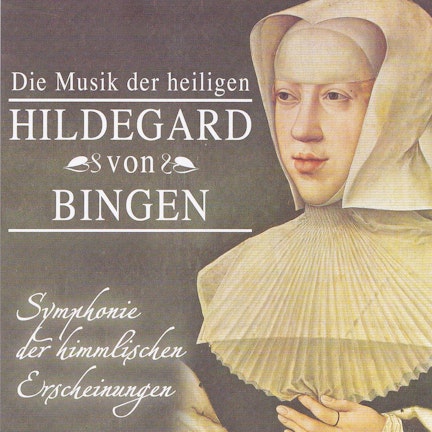
Hildegard von Bingen: Symphony of the Celestial Apparitions
Hieros
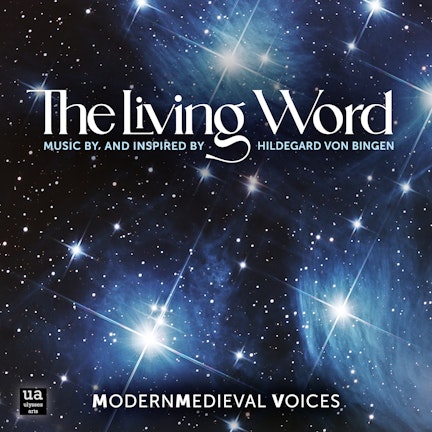
The Living Word
Christmas Music from Medieval Hungary
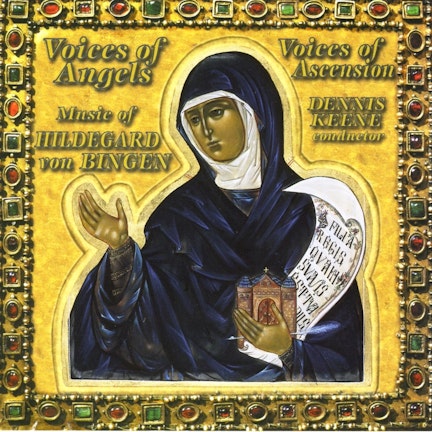
Hildegard of Bingen: Choral Music (Voices of Ascension)