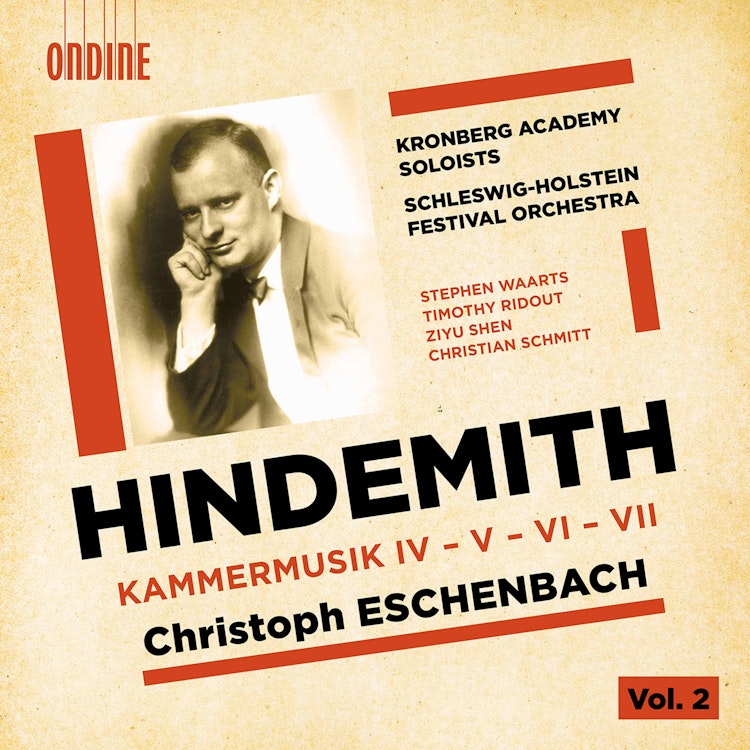
Kammermusik No. 7 is an 'audio document from the early years of radio transmission,' as Hindemith adapted its instrumentation and sound volume to the technical challenges of broadcasting at the time.
Composer's Artistic Vision
Hindemith defined a proper chamber orchestra as one with 'only a few instruments of a very specific character' that allows for 'genuine chamber-musical work,' rather than a reduced large orchestra.
Composer Biography
Paul Hindemith, the composer, returned from military service in December 1918 and resumed his work as concertmaster of the Opera House Orchestra in Frankfurt.
Composition History
Hindemith's seven Kammermusik works, including the four on this album, were written between 1922 and 1929, with the composer often performing in their premieres.
Instruments
For Kammermusik No. 4, Hindemith used a cornet à piston, an instrument initially found in military bands and jazz, and four drums described as 'tambourines without bells,' typical of a jazz band.
Composition History
Kammermusik No. 7 was commissioned by Südwestdeutsche Rundfunk AG (Southwest German Radio) for the inauguration of a new organ in its broadcasting hall in 1927.
Composer Biography
By 1929, Paul Hindemith had become a central figure in German music, having given up his orchestra post for an international concert career, performing as a violist in the Amar Quartet, and holding a professorship.
You might also enjoy...
Myslivecek: Music for Strings, Vol. 1 - 6 Concertante Symphonies
Duo Parnas NOW
Works by Kent Olofsson
Chamber Works
Saint-Lubin, L. De: Violin Virtuoso Works, Vol. 1 - Grand Duo Concertant / 2 Salonstucke / Potpourri
Trombone And Voice In The Habsburg Empire
Sessions, May, Rhodes
The Arditti Quartet
Rathgeber: Messe von Muri & Concertos
Deidre Gribbin: Island People
Tchaikovsky: Complete String Quartets
Memorias Tropicales
Byrne, Moran, Lurie & Torke: Works For String Quartet