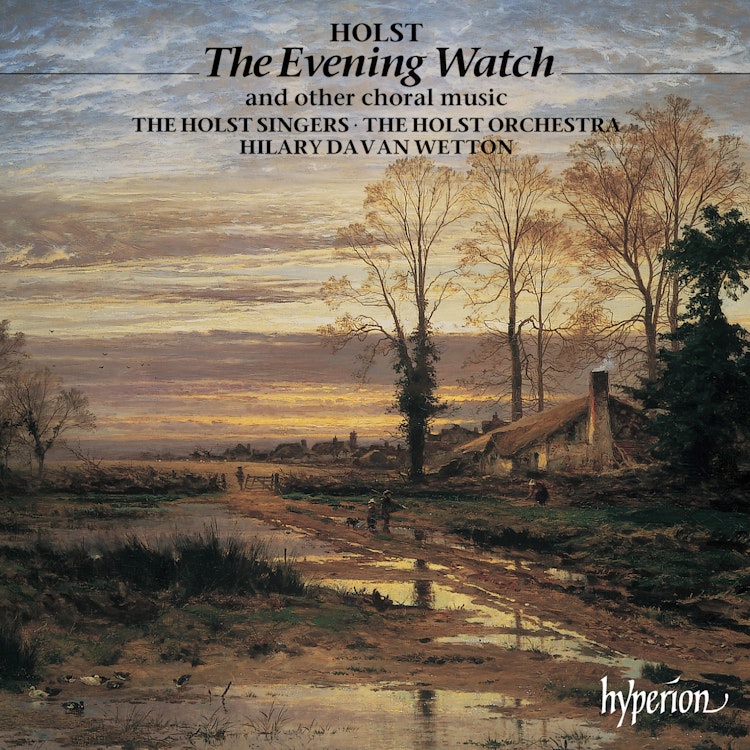
Holst: The Evening Watch, Nunc dimittis & Other Choral Works
9/29/2023, 17 Tracks, 1:04:37
Featuring
John Birch
Hilary Davan Wetton
Joya Logan
Christopher Mercer
Isobel Collyer
The Holst Singers
The Holst Orchestra
Gustav Holst
Did you know?
1/7
Composition History
The unaccompanied Nunc dimittis, H127, was written in 1915 for Richard Terry, organist of Westminster Cathedral, and remained in manuscript until a revised edition was published in 1979.
Composer's Artistic Vision
Holst was passionate about the music of Byrd and Palestrina, which is evident in the modal writing and antiphonal exchanges between male and female voices in his Nunc dimittis.
Compositional Technique
Holst was fond of unusual rhythmic meters, and in 'Intercession' he used a favorite 5/4 time, often shifting the subsidiary beat to emphasize the natural rhythm of the words.
Composition History
The Six Choruses, H186 (Op 53), composed between 1931 and 1932, represent Holst's last major creative utterance and his final work to be awarded an opus number.
Composer Biography
Gustav Holst (1874-1934) composed little religious music due to his ambivalent attitude towards the Church, finding the spiritual aspect appealing but feeling stifled by orthodoxy.
Composition History
Holst's Two Psalms, H117, were written in 1912, a period when his compositional style was undergoing textural and structural refinement.
Composer's Artistic Vision
Holst's later music, including the Six Choruses, is characterized by refinement of detail, economy of expression, and a tendency towards de-personalization and a cerebral style.
You might also enjoy...
Berkeley: Crux Fidelis / Missa Brevis / 3 Latin Motets / A Festival Anthem