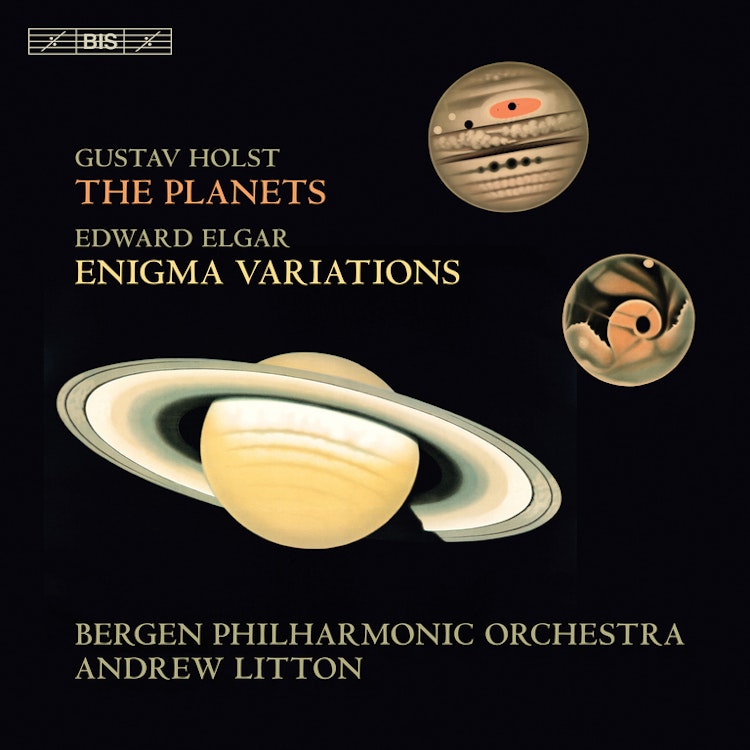
Two hugely popular English classics are performed by Andrew Litton and the Bergen Filharmoniske Orkester. Elgar's Enigma Variations of 1899 is his beautiful and varied set of portraits of his closest friends, including the popular 'Nimrod' variation, while Holst’s evergreen suite The Planets is a wonderfully inventive set of character sketches, beloved from Mars to Jupiter.
Featuring
Andrew Litton
Bergen Filharmoniske Orkester
Bergen Filharmoniske Kor
Edvard Grieg Kor
Edward Elgar
Gustav Holst
Did you know?
1/7
Composition History
Edward Elgar's Enigma Variations, composed between October 1898 and February 1899, was an immediate success at its London premiere on June 19, 1899, and helped establish his international reputation.
Performer Biography
Andrew Litton, the conductor on this album, served as the Bergen Philharmonic Orchestra's music director for 12 years (2003-2015) and was awarded the Royal Order of Merit by King Harald V of Norway for his work.
Compositional Technique
The Planets is scored for a large orchestra, including extensive percussion, two harps, celesta, organ, two sets of timpani, and rarer instruments like bass flute, bass oboe, and tenor tuba.
Historical Context
Elgar's international success with the Enigma Variations was notable as no British composer had achieved such international recognition since Henry Purcell's time, over two hundred years prior.
Composer's Artistic Vision
Holst intended The Planets to be musical evocations of human character as influenced by the planets, rather than being confused with classical mythology figures or astronomy.
Composition History
Gustav Holst's large-scale suite The Planets was conceived after his writer-friend Clifford Bax introduced him to astrology in 1913, with Holst composing it between 1914 and 1916.
Performer Biography
The Bergen Philharmonic Orchestra, founded in 1765, celebrated its 250th anniversary in 2015 and had a close relationship with Edvard Grieg, who was its artistic director from 1880-82.
You might also enjoy...
Delius: Florida & North Country Sketches
Coates: London Again Suite
Arnold, M.: Little Suites Nos. 1-3 / Concerto for 28 Players / Variations On A Theme of Ruth Gipps
Eric Coates: Orchestral Works, Vol. 4
Coates, E.: Phantasies / Suites / The Dambusters
Elgar/Holst - Orchestral Works
Prokofiev: Peter And The Wolf / Britten: The Young Person´s Guide To The Orchestra